Quick answer
You can usually switch carriers before your phone is paid off — but the remaining balance doesn't go away. Your old carrier will usually bill the remaining balance according to its payoff rules, and any promotional credits tied to staying may stop immediately.
Whether switching makes sense depends on three things: your payoff amount, whether your phone is unlocked (or can be), and whether the new carrier offers a buyout or switch deal that offsets the cost.
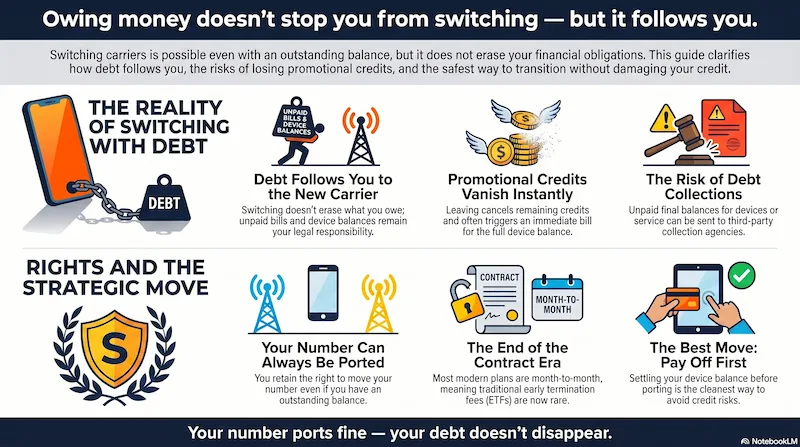
Infographic generated via NotebookLM from official carrier sources. Analysis by SwitchNinja Staff.
What actually happens when you switch with a balance
When you port your number to a new carrier, your old carrier typically treats the remaining device balance as something that must be resolved — whether on your final bill or through a separate payoff process. Instead of continuing monthly installments, the remaining balance may become due on your final bill, though the exact timing and handling can vary by carrier and financing type.
This catches people off guard. They switch to save $30/month on their plan, then get a $400 final bill from the old carrier a few weeks later. The savings are real — but so is the payoff obligation. You need to account for both.
Carrier-financed phone
You can often switch, but the remaining device balance is typically due on your final bill. Any promotional bill credits you were receiving (like a "free phone" deal paid out over 24–36 months) usually stop the month you leave.
Third-party financing (Affirm, Apple Card, etc.)
If your phone is financed separately from your carrier service, you may be able to switch carriers and continue making device payments to the lender independently — as long as the phone is unlocked and compatible with the new carrier.
Promotional credits
Leaving early can cancel remaining credits, which may make the switch far more expensive than you realize. If you're three months into a 36-month "free phone" deal, you're likely forfeiting 33 months of remaining credits.
3 strategies for switching when you still owe money
Strategy 1 — Best option
Let the new carrier buy you out
Many carriers offer switcher promotions that reimburse part or all of your remaining device balance when you come over. These deals require you to submit proof of your final bill (a screenshot or PDF from your old carrier), and the reimbursement typically comes as a prepaid card or bill credits over several months — not a single upfront payment.
The amounts and terms vary significantly by carrier and change frequently. Before assuming any specific offer applies to you, check the current promotion on the carrier's website and read the fine print — there are usually requirements around which device you're bringing, whether you need to trade it in, and how long you must stay to receive the full reimbursement.
How to use this strategy
Pay off your old phone (or let the final bill come in). Keep the bill as proof. Sign up with the new carrier, submit the final bill per their instructions, and receive the reimbursement on the timeline they specify. Don't cancel your old service before porting your number — you'll need your account number and transfer PIN.
Strategy 2
Trade in the old phone to offset the remaining balance
If you want a new phone anyway, a trade-in deal at the new carrier can help offset what you still owe. Here's the logic: you trade in your current device for credit toward a new phone. The trade-in value or promotional credit at the new carrier may help offset what you owe the old carrier — but timing and payout method matter.
The important thing to understand: you still legally owe the old carrier the remaining balance. The new carrier's trade-in credit doesn't pay off the old carrier directly — you need to use it to cover that final bill yourself. Plan for the timing: the new carrier's credit may arrive as monthly bill credits over 24–36 months, while the old carrier's final bill is due immediately.
The math to run
What you owe old carrier + cost of new plan over 24 months vs. trade-in credit value + new plan monthly savings. If the trade-in value and plan savings together exceed the old balance, the switch can pay for itself. Are carrier trade-in deals worth it? →
Strategy 3
Pay off the balance, then BYOD
If you don't want a new phone and the new carrier doesn't offer a buyout that covers your balance, the cleanest path is paying off the remaining amount, requesting an unlock from your current carrier, then bringing your now-unlocked phone to the new carrier at a much lower monthly rate.
This works especially well when switching to an MVNO — where plan prices can be $20–$35/month instead of $65–$90. Even after paying off a $300–$500 device balance, the monthly savings can recoup the cost within a year.
The math to run
Payoff amount ÷ monthly plan savings = months to break even. If you'd save $40/month and owe $400, you break even in 10 months. After that, it's pure savings. How BYOD works →
The locked phone problem — why you can't just swap SIMs
Carrier-financed phones are typically locked to the original carrier's network until the balance is paid and an unlock is processed. If you try to bring a locked, financed phone to a new carrier, the new SIM likely won't activate — you'll see an error or "no service."
Important
Porting your number to a new carrier is often what triggers the old carrier to accelerate the remaining balance. Don't assume the debt just disappears — check your financing agreement and your current carrier's early termination or payoff policies before you initiate a port.
For the phone to work on the new network, it must be unlocked. Most carriers will unlock a phone once the device balance is paid and unlock eligibility requirements are met — but the timeline and requirements vary. Some carriers have waiting periods even after full payoff. Plan accordingly if you're using a buyout strategy, since the unlock process may take several days after payment is confirmed. What is an unlocked phone? →
Steps to switch when you still owe money
Check your exact payoff balance
Log into your current carrier's app and find "Device Payoff Amount" or "Early Payoff." This is the number you need to plan around — not the remaining monthly payments.
Check if you're receiving promotional credits
Look at your bill for line credits, trade-in credits, or promotional discounts. Leaving early likely ends these. Factor that into the true cost of switching now vs. waiting.
Check what the new carrier is offering
Look for switcher deals, buyout offers, or trade-in promotions at the carrier you're considering. Read the fine print — requirements, reimbursement timelines, and eligible devices change frequently.
Run the IMEI compatibility check
Even if you're getting a buyout, confirm your phone will work on the new carrier's network before switching. Most carriers have a free BYOD or IMEI checker on their website.
Get your account number and transfer PIN — don't cancel first
Log into your old carrier account or call to get your account number and number transfer PIN. Do not cancel your old service before porting — canceling first can cost you your number and may affect buyout eligibility. How to port your number →
Switch, then handle the final bill
Complete the switch. Expect a final bill from your old carrier with any remaining balance. If you have a buyout deal, submit the required documentation promptly to the new carrier — submission deadlines vary by carrier and promotion, so check the specific terms of your offer.
Frequently asked questions
Can I switch carriers if I still owe money on my phone?▼
In many cases, yes — but switching doesn't erase the remaining balance. You typically still owe your current carrier or financing provider the unpaid device balance. The old carrier may bill the remaining amount on your final bill, and any promotional credits tied to staying with that carrier can stop when you leave. Whether it makes financial sense to switch depends on your payoff amount, whether the new carrier offers a buyout deal, and how much you'd save on the new plan.
Will switching carriers cancel my device payment plan?▼
Switching carriers typically does not cancel your device payment obligation — it accelerates it. When you port your number to a new carrier, the old carrier often treats the remaining balance as due on your final bill rather than continuing the monthly payment schedule. Check your financing agreement and current carrier's policies before switching to understand exactly what becomes due and when.
What is a carrier buyout or switcher deal?▼
Many carriers offer switcher promotions that reimburse part or all of your remaining device balance when you switch to them. These typically require you to trade in your old phone or show proof of the final bill from your previous carrier. The reimbursement often comes as a prepaid card or bill credits over several months — not a single upfront payment. Terms and amounts vary significantly by carrier and change frequently, so always verify the current offer before switching.
Can I bring a financed phone to a new carrier?▼
Only if the phone is unlocked. Carrier-financed phones are typically locked to the original carrier's network until the balance is paid and the carrier processes an unlock request. If you try to use a locked, financed phone on a new carrier, the SIM won't activate. Some carriers will unlock the phone once the device is paid off — but the timing and requirements vary by carrier.
⚡ The Bottom Line
You can switch — but you still remain responsible for what you owe.
Switching carriers with a device balance is often financially worth it — but only if you account for the full cost: payoff amount, lost promotional credits, and whether the new carrier's savings or buyout actually covers the difference.
Run the numbers before you port. If a new carrier is offering a meaningful buyout or your monthly savings break even within 12 months, the switch makes sense. If you're giving up significant promotional credits with 18+ months left, it may be worth waiting. See the full cost breakdown →
Figuring out where to go next? See our T-Mobile vs AT&T comparison or read the T-Mobile review.