Quick answer
Carrier trade-in deals are worth it only if you were already planning to stay on that carrier and plan for 24–36 months. The deal is genuinely good when the credit beats what you'd get selling the phone, and the required plan is one you'd choose anyway.
In many cases, single-line users come out ahead by buying a phone unlocked and using a cheaper prepaid plan — even after accounting for the "free" phone. The math often favors families, people with broken/old phones, and anyone who hasn't switched carriers in years and doesn't plan to. The exact outcome depends on the required plan cost and your old phone's resale value.
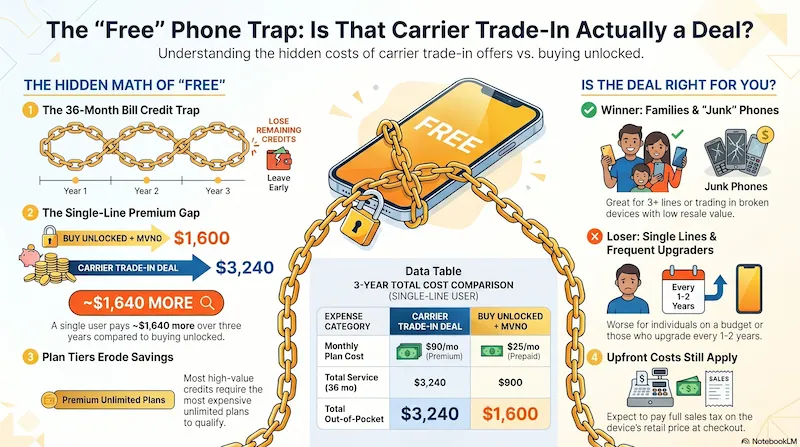
Visual summary created with NotebookLM · Research and analysis by SwitchNinja Staff.
How carrier trade-in deals actually work
Most carrier trade-in offers combine two things: the base value of your old phone (what it's actually worth) and an extra promotional credit layered on top. That promotional credit is what drives the big headline numbers — "$800 off," "$1,000 trade-in value" — and it almost always comes as monthly bill credits spread over 24–36 months, not upfront cash.
Think of it as a 0% loan for your new phone, with the carrier paying the installments for you — but only as long as you stay on the required plan, keep the line active, and don't leave before the term ends. If you do any of those things, the credits stop and you may still owe the phone's remaining balance.
⚠ The catch most people miss
The big promotional credits — the ones that make the headline number look impressive — are often tied to a higher-tier unlimited plan. The deal at the base plan level is usually far less generous. That monthly plan price difference is how carriers recapture part of the discount they're offering on the hardware.
The math that actually matters
Before accepting any trade-in offer, run this formula:
Net value of carrier deal =
+ Trade-in promo credit
− Extra plan cost vs. what you'd pay otherwise (× months)
− Lost credits if you leave early
− Any taxes or fees on the full device price
Here's a simple example using real-world numbers:
Single-line user: trade-in deal vs. buy unlocked
This is where the math gets uncomfortable for many carrier trade-in deals. The example below uses illustrative figures — promo terms and plan pricing change frequently, so run the same math with your actual offer:
| Carrier Trade-In Deal | Buy Unlocked + MVNO | |
|---|---|---|
| Phone cost | $0 (after $1,000 trade-in credits) | $1,000 upfront (or financed) |
| Old phone value | Surrendered to carrier | $300 cash (private sale or Apple trade-in) |
| Monthly plan | $85/mo (premium postpaid required) | $25/mo (prepaid/MVNO) |
| 36-month plan cost | $3,060 | $900 |
| Total out-of-pocket | $3,060 | $1,600 |
💡 What this shows
The single-line user taking the "free" phone deal pays $1,640 more over three years. The carrier is recovering the hardware subsidy through the higher monthly plan cost — and then some. The deal isn't a scam, but it's also not free money. It's a financing structure designed to keep you on a premium plan.
When carrier trade-ins are worth it
✓ Family plans with 3+ lines
Multi-line discounts close the gap between postpaid and prepaid pricing significantly — often bringing the per-line cost down to $40–$50. When four people all receive "free" phones, the total hardware savings ($4,000+) can genuinely outweigh the premium service cost. The math works for families in a way it rarely does for individuals.
✓ Your old phone is broken or nearly worthless
In 2026, major carriers are running "any condition" trade-in promos — accepting cracked screens, non-working devices, and older models for $800–$1,000 in credits. If your old phone would sell for $50 on the open market but the carrier gives you $800 in credits, that gap is real savings — provided you were going to stay on a premium plan anyway.
✓ You haven't switched in years and don't plan to
If you've been on the same carrier for five years, don't think about switching, and were already going to stay — the bill credits are essentially found money. The plan cost is what it would have been regardless. The trade-in promo just lowers your effective device cost.
✓ The required plan is one you'd choose anyway
If the deal requires the same plan tier you'd pay for regardless, there's no plan premium eroding the credit. That's the cleanest version of this deal — the carrier credit is genuinely additional value, not a disguised price increase on the service.
When carrier trade-ins are a bad deal
✗ You're a single-line user on a budget
As the table above shows, a single-line user almost always saves more by buying a phone unlocked and going with a $25–$35/mo prepaid plan. The "free" phone effectively costs more through three years of premium plan pricing.
✗ You like to upgrade every 1–2 years
Credits take 36 months to fully pay out. If you want a new phone before then, you'll leave credits behind. Frequent upgraders often come out better buying outright (or using installment financing through Apple, Samsung, or Google) and trading up when they're ready.
✗ You might switch carriers in the next 3 years
If a better deal comes along — a price drop, a new carrier promotion, a move to a different city — you'll lose all remaining bill credits the moment you leave. You also may owe the remaining phone balance. The deal punishes you for switching, which is exactly the point.
✗ Your old phone has strong resale value
Recent flagship iPhones and Samsung Galaxy S models hold value well on the private market. If you can sell your current phone for $400–$600 cash, that money is immediate and flexible — you can use it on any plan, any carrier, or anything else. Carrier credits are illiquid and conditional.
Common gotchas to watch for
Taxes on the full phone price
It's common for carriers and retailers to charge sales tax on the phone's full retail price upfront — not the post-credit price. This varies by state and transaction structure, but in states like California it's mandated on the full unbundled price. On a $1,000 phone in a 10% tax state, that's $100 due at purchase, even though the credits reduce your effective cost later.
Plan eligibility requirements
Most high-value credits are locked to the carrier's most expensive plan tier. Downgrading plans mid-deal — even if you're still a customer — can void the remaining credits entirely.
Device condition requirements
"Any condition" promos are real — but read the fine print. Some require the phone to power on, have an identifiable IMEI, or be a specific model year or newer. Submitting a phone that doesn't qualify can reduce or eliminate the credit after the fact.
The "switching bonus" trap
Carriers sometimes advertise trade-in deals specifically for switchers from other networks. These offers often require porting your number, activating a new line, and staying for a minimum period — if you don't meet every condition, the credits may be clawed back months later.
💡 The one question that decides everything
What is my total cost over 24–36 months?
Not the monthly price. Not the trade-in value. Not the "free phone" headline. Add up every dollar you'll pay — service plan, taxes, fees — over the full promo term, then compare that to buying a phone outright and using a cheaper plan for the same period. That total is the only number that matters.
Frequently asked questions
Are carrier trade-in deals worth it?▼
Sometimes. A carrier trade-in is worth it if you were already planning to stay on that carrier for the full promo period (24–36 months), the required plan is one you'd choose anyway, and the credit is clearly higher than what you'd get selling the phone yourself. If any of those conditions are shaky, selling the phone and using a cheaper plan usually wins.
How do carrier trade-in credits actually work?▼
Carrier trade-in credits are not upfront cash. They're spread as monthly bill credits over 24–36 months. If you leave the carrier early, cancel your line, or downgrade to an ineligible plan, the remaining credits stop — and you may still owe the phone's balance.
What happens if I leave a carrier before my trade-in credits run out?▼
You lose all remaining bill credits immediately. You also typically still owe the remaining balance of the phone's full retail price. Leaving halfway through a 36-month deal can cost you hundreds of dollars in lost credits plus whatever you still owe on the device.
When is a carrier trade-in a bad deal?▼
A carrier trade-in is usually a bad deal for single-line users, frequent upgraders, and anyone who might switch carriers before the promo term ends. If the deal requires a more expensive plan than you'd otherwise choose, that extra monthly cost often wipes out the headline credit value.
⚡ The Bottom Line
Carrier trade-in deals aren't scams — they're a trade.
You get a discounted phone. The carrier gets your long-term commitment to a premium plan. For families, "set it and forget it" users, and anyone with a worthless old phone, that trade can be genuinely worth it. For single-line users, frequent switchers, and anyone who values flexibility — the cash-sale route almost always wins.
If you want a new phone without the 36-month golden handcuffs: buy it unlocked directly from Apple, Samsung, or Google. Many offer installment financing and instant trade-in value with no carrier lock-in — then pick any plan you want.
Comparing carriers before you commit to a trade-in deal? See our T-Mobile vs AT&T comparison or read the T-Mobile review.