Quick answer
Postpaid means you use service first and pay at the end of the month — like a utility bill. It's what Verizon, AT&T, and T-Mobile sell directly. You often get device financing or trade-in promos, but you're billed monthly and may be locked into a 24–36 month device payment plan.
Prepaid means you pay upfront before using service. No credit check, no contract, no surprise bills. Most budget carriers — Mint, Visible, Tello, Cricket — are prepaid. Same towers as the big carriers, significantly lower prices.
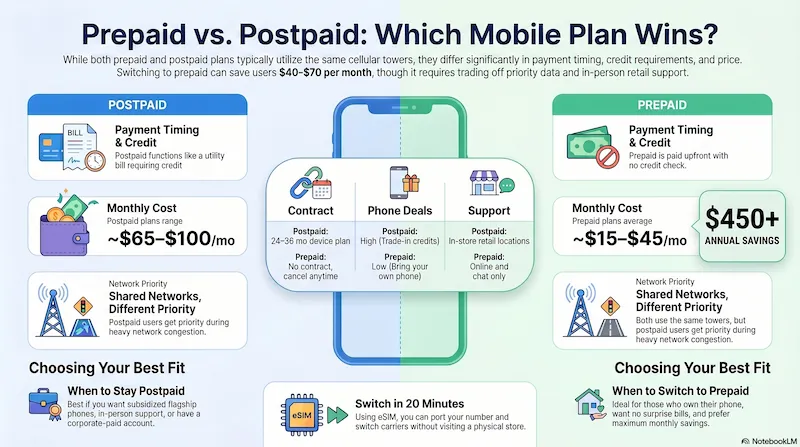
Visual summary created with NotebookLM · Research and analysis by SwitchNinja Staff.
The core difference: when money changes hands
With postpaid, the carrier extends you credit. You use data, calls, and texts all month, then get a bill. The carrier is essentially trusting you to pay. That's why postpaid plans often require a credit check — the carrier is taking on financial risk.
With prepaid, you pay first, then use service. When your balance runs out, service pauses until you refill — no surprise overage charges. No credit check required because the carrier holds no risk. This is also why prepaid plans can be so much cheaper: lower overhead, no bad debt risk, no retail store markup.
The underlying network is often the same — prepaid customers on Mint Mobile (T-Mobile network) use the same infrastructure as T-Mobile postpaid customers. But performance can differ during congestion, and some plan features like roaming or hotspot may vary. For most people in most places, the day-to-day experience is nearly identical.
| Postpaid | Prepaid | |
|---|---|---|
| When you pay | End of month (billed) | Upfront (before use) |
| Typical 1-line cost | $65–$100/mo | $15–$45/mo |
| Contract | Often 24–36 mo device plan | No contract, cancel anytime |
| Credit check | Usually required | Not required |
| Phone deals | Trade-in credits, promos | Bring your own phone |
| Network priority | Higher during congestion | Lower (deprioritized) |
| In-store support | Yes — retail locations | Usually online/chat only |
| Taxes included | Rarely — added to bill | Often yes (Visible, Cricket) |
| Coverage | Same underlying network; may differ during congestion | Same underlying network; may differ during congestion |
The real cost gap — and why most people don't see it
A real comparison — same T-Mobile network:
- T-Mobile Essentials (postpaid): $60/mo + taxes ≈ $68/mo actual
- Mint Mobile Unlimited (prepaid): $30/mo annual — taxes included
- Difference: ~$38/month = $456/year
Both use T-Mobile infrastructure. Exact savings vary by taxes, fees, and promos. The main trade-offs with Mint are priority data during congestion and no walk-in store support.
Most people don't make this comparison because they signed up for postpaid years ago, and switching feels complicated. It isn't — especially with eSIM, you can be on a new prepaid plan in under 20 minutes without visiting a store.
Carriers often emphasize perks and device deals to make postpaid feel more valuable — streaming bundles, trade-in credits, and loyalty rewards all help obscure a price gap that most customers never stop to calculate.
When postpaid actually makes sense
Prepaid is usually cheaper on a monthly basis — but postpaid has legitimate reasons to choose it:
Trade-in promos can knock $600–$1,000 off a new iPhone or Samsung. Genuinely valuable if you account for the higher monthly cost over 36 months. See the full math →
Having a physical store to walk into has real value. Many prepaid carriers rely mainly on online and chat support, with limited or no retail presence.
NYC, LA, Chicago — if you regularly hit peak-hour congestion, the priority data advantage of postpaid may be worth the premium.
If a corporate account is covering it, optimize for features and support, not price.
Which carriers are prepaid vs postpaid?
| Carrier | Type | Network |
|---|---|---|
| Verizon | Postpaid | Verizon |
| AT&T | Postpaid | AT&T |
| T-Mobile | Postpaid | T-Mobile |
| Visible | Prepaid | Verizon |
| Metro by T-Mobile | Prepaid | T-Mobile |
| Cricket Wireless | Prepaid | AT&T |
| Mint Mobile | Prepaid | T-Mobile |
| Straight Talk | Prepaid | Multi-network / device dependent |
| US Mobile | Prepaid | Multi-network / plan dependent |
| Tello | Prepaid | T-Mobile |
Frequently asked questions
Will switching to prepaid hurt my credit score? ▼
Can I keep my phone number when switching from postpaid to prepaid? ▼
Can I use my current phone on a prepaid plan? ▼
Is there a middle ground between prepaid and postpaid? ▼
What happens if I don't pay my prepaid bill on time? ▼
⚡ The Bottom Line
For most people, prepaid is the smarter choice — and the savings are real.
If you already own an unlocked phone and don't need in-store support, switching to prepaid can save a meaningful amount each month — often $30–$50 — on the same underlying network. The main reasons to stay postpaid are a device financing deal, regular in-store support, or a corporate account that covers the cost. See the best no-contract prepaid plans →
Ready to go prepaid? Compare your options: Mint Mobile review, Visible review, and Cricket Wireless review.