Quick answer
An MVNO (Mobile Virtual Network Operator) is a wireless carrier that rents network access from Verizon, AT&T, or T-Mobile instead of owning its own towers. Your phone usually connects to the same underlying network as the host carrier — but real-world experience can still differ because of priority, roaming rules, and plan features.
MVNOs are cheaper because they don't pay for towers, retail stores, or massive marketing budgets. They often pass a portion of those savings to you. Savings vary by plan tier, taxes, and promos — but switching from a premium postpaid line to an MVNO can meaningfully lower your monthly bill.
The real trade-off isn't coverage — it's data priority during network congestion. When a tower is overloaded, the big carrier's own customers get first priority. MVNO customers may see slower speeds during peak hours. In most areas, most of the time, you won't notice the difference.
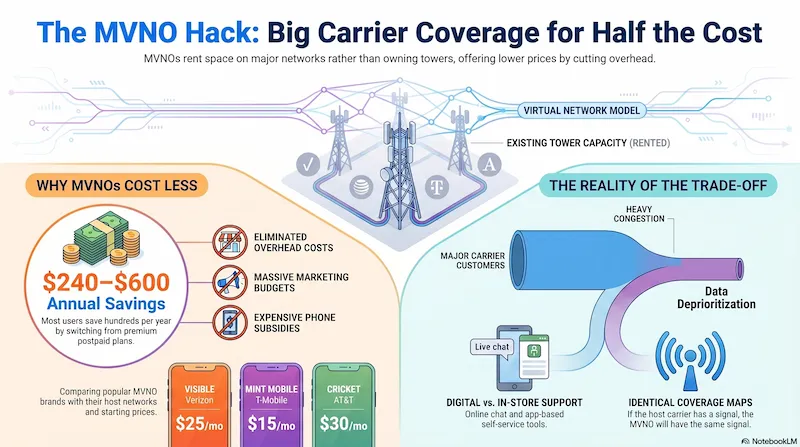
Visual summary created with NotebookLM · Research and analysis by SwitchNinja Staff.
The short answer: they rent the towers instead of owning them
MVNO stands for Mobile Virtual Network Operator. The "virtual" part is the key. An MVNO doesn't own any cell towers. Instead, it pays Verizon, AT&T, or T-Mobile for the right to use their network — then resells that access to you at a lower price under its own brand.
Your phone usually connects to the same underlying network as the host carrier. The difference is who you're paying — and how much. Real-world experience can still vary based on priority, roaming rules, and what your specific plan includes.
Which MVNOs run on which networks?
- Verizon network: Visible (Verizon-owned, digital-first)
- T-Mobile network: Mint Mobile (T-Mobile-owned, acquired 2023), Tello, Metro by T-Mobile (T-Mobile-owned prepaid brand)
- AT&T network: Cricket Wireless (AT&T-owned prepaid brand)
- Verizon network (also): Straight Talk (TracFone brand, Verizon network); US Mobile (Verizon, T-Mobile, or AT&T — varies by plan)
| MVNO | Host Network | Best For | Starts At | Notes |
|---|---|---|---|---|
| Visible | Verizon | Unlimited data, flat pricing | $25/mo | Verizon-owned, digital-first |
| Mint Mobile | T-Mobile | Multi-month savings | $15/mo | T-Mobile-owned (acquired 2023); prepaid, 3/6/12-month blocks |
| Tello | T-Mobile | Light users, flexible plans | $10/mo | Build-your-own data plan |
| Cricket | AT&T | AT&T coverage, taxes included | $30/mo | AT&T-owned prepaid brand |
| Metro by T-Mobile | T-Mobile | T-Mobile coverage at lower cost | $25/mo | T-Mobile-owned prepaid brand |
| US Mobile | Verizon / T-Mobile / AT&T | Network choice | $10/mo | Pick your network; varies by plan |
Prices as of April 2026 and may vary. Always verify with the carrier before signing up.
Why are MVNOs so much cheaper?
Building a nationwide cell tower network costs billions per year. MVNOs skip all of that — they pay a wholesale rate to use an existing network and pass the savings to you.
Verizon and AT&T have thousands of physical stores with rent, staff, and overhead. Most MVNOs are online-only — $0 in retail costs. That's partly why your Verizon plan costs $80 and a Visible plan costs $25.
Trade-in promos are baked into your monthly rate over 36 months. MVNOs don't offer device deals — so they don't charge you for them. Are trade-in deals worth it? →
Many MVNOs include taxes in the advertised price. A Visible plan at $25 costs $25. A Verizon plan at $80 often runs $90–$95 after fees and surcharges. That gap is real money.
What's the actual catch?
When a tower gets crowded — a stadium, rush-hour city center — the carrier prioritizes its own postpaid customers first. Most people never notice this. If you're regularly in very dense areas at peak hours, you might see occasional slowdowns.
Big carriers have retail stores where you can walk in with a problem. Most MVNOs are phone or chat only. Fine for most issues, but can be frustrating for complex problems.
You'll need to bring your own unlocked phone or buy one outright. Increasingly easy — most phones today are unlocked — but MVNOs don't offer carrier upgrade deals.
Are MVNOs reliable?
For the vast majority of users: yes. The signal is the same signal. If T-Mobile covers your neighborhood, Mint Mobile covers your neighborhood. If Verizon works at your home, Visible works at your home.
The reliability question is really about priority, not coverage. Coverage area is usually the same as the host network, but speeds and priority can differ when the network is busy. For most people in most places, the difference is rarely noticeable.
Who should consider an MVNO?
Already own an unlocked phone, don't need in-store support often, and want to cut your bill by $20–$50/month. See why your bill is high →
Want a new subsidized phone, need hands-on store support, or work in a job where network reliability is non-negotiable (e.g., emergency services).
⚡ The Bottom Line
MVNOs are one of the biggest opportunities to cut your phone bill without giving up the major networks.
Most Americans pay $65–$90/month to Verizon, AT&T, or T-Mobile. An MVNO on the same network costs $25–$45. That's $240–$600 per year in savings for the exact same signal. The only question is which MVNO fits your specific situation. See the best MVNOs ranked for 2026 →
Want to see MVNOs in action? Read our US Mobile review, Visible review, and Mint Mobile review — three very different MVNOs on the same major networks.