Quick answer
Your bill is high because it's usually several things stacked together — not just your plan price. The most common culprits: device financing on a new phone, a premium unlimited plan required to get that "free" device, taxes and regulatory fees, and add-ons like insurance or streaming bundles you signed up for and forgot.
The fastest check: look at your bill and ask whether your phone is actually paid off. If it's not, that device payment is likely the biggest single line item — and removing it (by paying it off or switching to an unlocked phone next time) can cut your bill significantly.
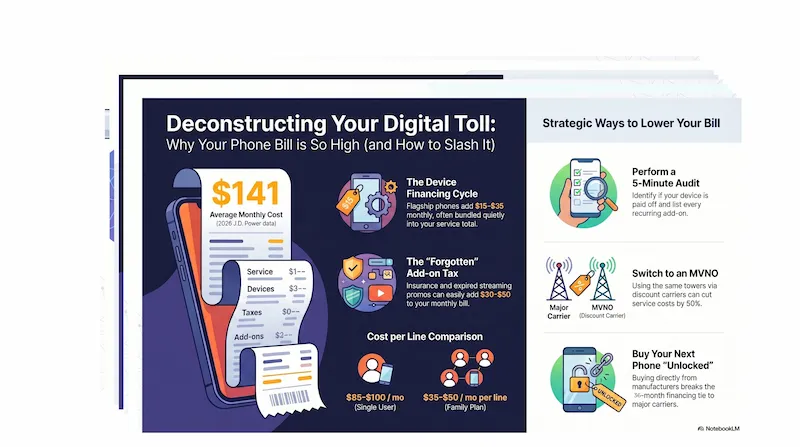
Infographic generated via NotebookLM from official carrier policy sources. Analysis by SwitchNinja Staff.
Average U.S. cell phone bill (J.D. Power, 2026)
$141 / month
Estimated average per J.D. Power — includes service plan + device financing + taxes + add-ons
1. Your phone payment (the biggest surprise)
The era of the $200 subsidized phone has largely ended at the major carriers. A flagship iPhone or Samsung Galaxy now costs $1,000–$1,200 at full retail. Most people finance it over 24–36 months through the carrier — which adds $15 to $35 per month on top of your service plan, sometimes quietly bundled into the same bill.
The catch: even when a carrier advertises a "free" phone, you're often still seeing monthly charges. The promotional trade-in credit reduces the effective cost, but if it didn't cover the full price, you're still carrying a device payment. And if you're paying for phone insurance on top of that — common carrier protection plans now run $12–$25 per month — that's up to $900 in insurance charges alone over a 36-month term.
🔍 Check this first
Log into your carrier account and look for a line labeled "Device Payment," "Equipment Installment," or "Next." If that line exists, your phone isn't paid off — and that amount disappears the moment it is. Many people don't realize they've been paying a device installment for years past the point they could have switched to a cheaper plan.
2. The plan premium trap
Carriers price their cheapest plans low to attract attention, then make the best phone deals — "$1,000 trade-in credit," free streaming bundles, priority data — available only on their premium unlimited tiers. A single-line user on Verizon Unlimited Ultimate ($85/mo) or T-Mobile Experience More ($85/mo) is paying $85+ per month for service alone before taxes and fees.
There's also a legacy price problem. In 2026, major carriers have raised prices on older and "retired" plan tiers by $5–$10 per month. If you haven't reviewed your plan in two years, you may be paying a quiet penalty for staying on a plan the carrier would rather you leave.
⚠ The autopay trap
Most carriers offer a $5–$10/month autopay discount — but many now require a debit card or bank account (not a credit card) to qualify. If you recently switched payment methods to a credit card, that discount may have silently disappeared, adding up to $120 a year to your bill.
3. Taxes and fees you didn't expect
Wireless bills carry a layered stack of charges that don't appear in the advertised plan price: federal Universal Service Fund fees, state and local taxes, and carrier-specific surcharges with names like "Regulatory Programs Fee" or "Telecommunications Recovery Fee." These vary by state and city — two people on the exact same plan in different zip codes can pay meaningfully different totals each month.
Carriers have also been steadily raising their own administrative fees. T-Mobile, for example, increased its Regulatory Programs and Telecommunications Recovery Fee to $4.49 per line in recent billing cycles. These aren't government charges — they're carrier revenue, just labeled to look like pass-throughs. See the full breakdown of phone bill taxes and fees →
4. Add-ons you forgot about
Carriers have quietly become bundle merchants. Each add-on looks small on its own — $5 here, $12 there — but together they can push a reasonable bill into "why is this so high?" territory. Common culprits:
Phone insurance / device protection
AppleCare+ via carrier, Asurion, or carrier-branded protection plans
Streaming bundles (after promo period)
Disney+, Netflix, Hulu, Apple TV+ — free for 6–12 months, then auto-convert to paid
Cloud storage
Carrier-branded cloud backup services — easy to add, easy to forget
Early upgrade / "Next Up" feature
Allows early phone upgrades — useful if you upgrade every year, useless if you don't
International / roaming add-ons
Travel passes or calling add-ons added for a trip and never removed
5. The single-line tax
The wireless industry is built for families. Multi-line accounts get bulk discounts that make the per-line cost much more reasonable. Solo users don't get that discount — they typically pay the full single-line rate, which is where the pain is most concentrated.
| Plan type | Typical cost per line (postpaid, before taxes) |
|---|---|
| 1 line | $85–$100/mo |
| 4 lines (same plan) | $35–$50/mo per line |
Illustrative ranges — exact pricing varies by carrier, plan tier, promotions, and taxes.
That's why a family plan that looks expensive in total is often a good deal per person — and why solo users tend to feel the squeeze the hardest. If you're a single-line user on a major carrier, prepaid and MVNO alternatives on the same network can offer a dramatic price difference.
How to audit your bill in 5 minutes
Step 1 — Is your phone paid off?
Look for "Device Payment" or "Equipment Installment" on your bill. If it shows $0 or doesn't appear, you own your phone outright. If it shows a balance, that's how much you're adding to your bill each month just for the device. Note: if you decide to switch carriers before the balance is paid off, the full remaining amount is typically due immediately.
Step 2 — List every add-on
Open your account and look at every line item below the base plan. Insurance, cloud storage, streaming add-ons, upgrade features — list them all and ask: do I actually use this? Remove anything you don't actively use.
Step 3 — Check your actual data usage
Look at your last 3 months of data usage in your carrier app. Many people pay for unlimited data when they use 5–10GB and are on Wi-Fi most of the day. A capped plan at a lower price tier could save $15–$30/month with zero noticeable difference.
Step 4 — Confirm your autopay discount
Check that your autopay method qualifies for the discount. Many carriers now require a debit card or bank account rather than a credit card — though terms vary by plan and carrier. If you recently changed payment methods, this discount may have silently dropped off.
How to actually lower your bill
Fastest: remove unused add-ons today
Insurance, streaming bundles past their promo window, upgrade features you never use — these can easily add $30–$50/month. Removing them takes 10 minutes and shows up on your very next bill.
High impact: switch to an MVNO
Carriers like Mint Mobile, Visible, and US Mobile run on the same Verizon, T-Mobile, and AT&T towers — for $25–$45/month on an unlimited plan with no contract. If your phone is paid off, switching today could cut your bill in half. The quiz below can show you exactly which plan fits your usage.
Medium impact: downgrade your plan tier
If your phone is paid off and you're not using all your data, moving from a premium unlimited to a mid-tier plan can save $15–$25/month on the same carrier. Call your carrier and ask what the cheapest plan that covers your actual usage looks like.
Long-term: buy your next phone unlocked
Buying a phone unlocked — directly from Apple, Samsung, or Google — breaks the device financing cycle. You own it outright, you're not tied to a 36-month plan, and you can move to any carrier any time. Combined with an MVNO plan, this is often the lowest possible total cost of ownership. What is an unlocked phone? →
Free: use Wi-Fi more aggressively
Connecting to Wi-Fi at home, work, and common locations reduces your cellular data usage — which may let you drop to a lower (cheaper) data plan tier altogether. Wi-Fi calling can also replace cellular minutes at no cost →
Frequently asked questions
Why is my cell phone bill so high?▼
Most high cell phone bills are a combination of device financing (paying off your phone over 24–36 months), a premium unlimited plan, taxes and surcharges, and forgotten add-ons like insurance or streaming bundles. The plan price is often not the biggest line item — the phone itself is.
What is the average cell phone bill in the US?▼
The average monthly U.S. cell phone bill is around $141 per month according to J.D. Power data from early 2026. That figure includes device financing, service plans, taxes, fees, and add-ons across all carrier types.
How can I lower my cell phone bill?▼
The fastest ways to lower your bill are: remove unused add-ons (insurance, streaming bundles, cloud storage), confirm your phone is actually paid off, switch to a lower plan tier if you're not using all your data, and consider an MVNO like Mint Mobile, Visible, or US Mobile — which use the same towers as major carriers at a fraction of the price.
Why did my cell phone bill go up?▼
Common reasons for a sudden bill increase include: a streaming bundle promo expiring and converting to a paid add-on, a carrier raising prices on legacy or older plan tiers, an autopay discount being lost after switching payment methods, or a new device financing charge kicking in after an upgrade.
⚡ The Bottom Line
Your bill is probably high because of things that aren't the plan.
Device financing, forgotten add-ons, a premium plan tier you were pushed into, and the single-line tax all stack on top of the base price. Auditing those four things takes less than 10 minutes and may reveal meaningful charges you can reduce or eliminate without giving much up — results vary by what's on your bill.
If your phone is fully paid off, you have strong leverage to reduce your bill — switching to an MVNO on the same network could cut your service cost by 50% or more. Even with a remaining device balance, dropping unused add-ons or downgrading your plan tier can still make a real difference today.
Ready to compare what you're paying against what's available? See our AT&T vs T-Mobile comparison or read the T-Mobile review.