Quick answer
Most people need less data than they think — if they have reliable Wi-Fi at home and work. Light users (email, maps, social) typically use 1–5 GB/month. Average users (social, music, occasional video) use 5–15 GB. Heavy streamers and hotspot users often exceed 20–30 GB and are the best candidates for unlimited.
The fastest way to know: check your phone's actual data usage right now (instructions below). One month of real data beats any estimate.
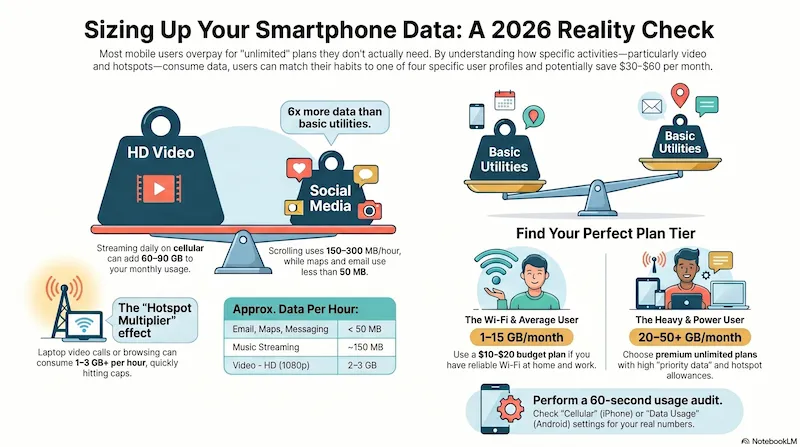
Infographic generated via NotebookLM from official carrier policy sources. Analysis by SwitchNinja Staff.
What your favorite activities actually cost in data
Most people underestimate how fast video eats data and overestimate how much everything else uses. Here's a practical breakdown:
| Activity | Data per hour (approx.) | Notes |
|---|---|---|
| Social media scrolling | 150–300 MB | Video-heavy feeds (TikTok, Reels) use more than static photo feeds |
| Music streaming | ~150 MB | High-fidelity lossless audio can use significantly more |
| Video — SD (480p) | ~700 MB | Standard on basic unlimited plans that cap video quality |
| Video — HD (1080p) | ~2–3 GB | Standard for most smartphones; one hour daily on cellular ≈ 60–90 GB/month in that scenario |
| Video calls | 600 MB–1.5 GB | Varies by app and video quality setting |
| Mobile hotspot (laptop browsing) | 1–3 GB+ | Highly variable; video calls or streaming on laptop multiplies usage fast |
| Email, maps, messaging | < 50 MB | Negligible — these barely move the needle |
Approximate figures — actual usage varies by app, quality settings, and content type.
The key insight
Video is typically the biggest driver of high data usage — but hotspot, video calls, and video-heavy social feeds can also push usage past 20–30 GB quickly. Email, maps, music, and text-based social media add up slowly. As a rough scenario: if you stream one hour of HD video daily on cellular, that alone can add 60–90 GB to your monthly usage. If you stream video on cellular daily or use hotspot often, unlimited makes sense. If you mostly use Wi-Fi, a capped plan probably covers you comfortably.
Which type of user are you?
The Wi-Fi User
1–5 GB/monthYou have Wi-Fi at home and work. You use your phone for messaging, email, music on the commute, and occasional maps. You're rarely watching video on cellular — you save that for home. You may not even think about your data usage because you rarely hit your cap.
Best plan fit
A small capped plan (5–10 GB) from an MVNO like Tello or US Mobile can cost $10–$20/month and cover everything you need. You could be spending $40–$60/month less than an unlimited plan for the same real-world experience. Best plans for light users →
The Average User
5–15 GB/monthYou scroll social media, stream music on the go, watch some video on cellular (but not daily), and occasionally use maps heavily during travel. You have Wi-Fi at home but not always at work. You think about data occasionally but don't obsessively track it.
Best plan fit
You likely don't need premium unlimited. A mid-tier plan (15–20 GB) or a budget unlimited from an MVNO like Mint Mobile or Visible gives you breathing room without overpaying for data you won't use. Best plans under $30 →
The Heavy User
20–50 GB/monthYou stream HD video regularly on cellular, spend significant time away from Wi-Fi, and frequently use your phone as a hotspot for a laptop or tablet. You've hit data caps before and felt the throttle. Cellular data is a meaningful part of your daily productivity.
Best plan fit
Unlimited makes sense here — but focus on plans with generous high-priority data and a solid hotspot cap. Budget unlimited plans often deprioritize or throttle hotspot too aggressively for heavy users. What unlimited plans actually include →
The Power User
50 GB+/monthYour phone is your primary computer. You use hotspot as your main internet connection, stream HD or 4K video daily, work remotely from locations without reliable Wi-Fi, or use data-intensive apps constantly. You've probably already hit your plan's cap and felt the difference.
Best plan fit
Premium unlimited from a major carrier with high-priority data and a generous hotspot allowance. You're often paying for priority data that won't slow during congestion, a hotspot cap high enough for real work, and a higher threshold before any slowdowns kick in — not just the word "unlimited" on the label. Best value unlimited plans →
Two things that skew your usage more than you'd expect
1. Why hotspot changes the math
Even if your plan says "Unlimited," hotspot data almost always has its own separate cap — often 15–50 GB at high speed depending on tier, then throttled to very slow speeds. If you work from coffee shops or anywhere without reliable Wi-Fi, the hotspot cap is the most important number on your plan — not the phone data limit. One video call on a laptop can use as much data as a full day of phone use. How hotspot data caps work →
2. Background app activity
Apps sync, update, and back up in the background even when you're not using them — photo libraries, cloud storage, social media, and streaming apps are common culprits. If your data usage seems higher than your actual screen time suggests, check which apps are consuming data in the background. On iPhone: Settings → Cellular → scroll down to see per-app usage. On Android: Settings → Network & Internet → SIMs → App Data Usage.
Find your real number in 60 seconds
Don't guess — your phone already knows exactly what you use. Here's how to check:
iPhone
Settings → Cellular → scroll down to "Current Period" to see your total. Scroll further to see usage broken down by app. Reset the counter monthly if you want accurate ongoing tracking (Settings → Cellular → scroll to bottom → Reset Statistics).
Android
Settings → Network & Internet (or Connections on Samsung) → Data Usage. You can set a data warning here so you get notified before hitting your cap. Exact labels vary by manufacturer and Android version.
Your carrier's app will also show usage in the billing cycle — sometimes more accurately than the phone's built-in counter, which may include Wi-Fi in some views.
A note on "unlimited" — it's more complicated than it sounds
If you decide you need unlimited, be aware that not all unlimited plans deliver the same experience. "Unlimited" means you won't be cut off or charged overage fees — but it doesn't always mean full-speed data all month:
Priority/deprioritization: Basic unlimited tiers are often deprioritized when towers are busy — you'll have full bars but significantly slower speeds in crowded areas. How deprioritization works →
Soft cap/throttling: Many plans reduce speeds after a certain amount of high-speed data usage — even if they call themselves unlimited. What throttling means →
Hotspot cap: Phone data may be unlimited, but hotspot typically has its own separate limit — even on premium plans.
The practical implication: if you're comparing unlimited plans, look at the priority data allotment and hotspot cap, not just the word "unlimited." Full breakdown of what unlimited actually includes →
Frequently asked questions
How much data does the average person use per month? ▼
Is 10 GB of data enough per month? ▼
Do I really need an unlimited plan? ▼
How much data does video streaming use? ▼
⚡ The Bottom Line
Check your actual usage first. Then pick a plan that matches it — not one that sounds safe.
If you use Wi-Fi at home and work, you're likely paying for far more data than you use. A capped MVNO plan at a fraction of the price will cover your real-world needs just as well — and save you $30–$60/month.
If you stream video daily on cellular, use hotspot for work, or spend significant time away from Wi-Fi, unlimited is the right call — just make sure it's an unlimited plan with enough priority data and hotspot to match your actual usage, not just the word "unlimited" on the label.
Found your data range? Compare your options: Mint Mobile vs Tello comparison or read the Mint Mobile review.