Quick answer
Deprioritization means your data can be temporarily slowed when a cell tower is congested — because higher-priority users get served first. It is not a permanent speed cap and not the same as throttling. When congestion clears, your speed returns to normal.
Many budget and MVNO plans are deprioritized by default — it's a core reason they cost less. But it depends on the specific plan and carrier: some newer premium prepaid tiers (like Visible+ and US Mobile's Unlimited Premium) now include priority data comparable to major carrier postpaid plans. If you're on a mid-tier or premium unlimited plan, you typically get a set amount of priority data before deprioritization can apply.
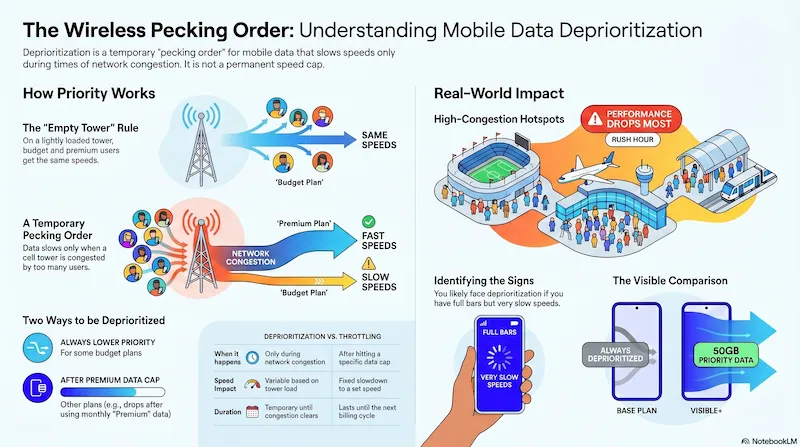
Visual summary created with NotebookLM · Research and analysis by SwitchNinja Staff.
Deprioritization vs throttling — the key difference
These two terms get confused constantly, but they work very differently:
| Deprioritization | Throttling | |
|---|---|---|
| When it happens | Only when a tower is congested | After you hit a data cap, regardless of network load |
| Speed impact | Variable — depends on how busy the tower is | Fixed slowdown — often reduced to a low set speed until billing cycle resets |
| How long it lasts | Temporary — clears when congestion clears | Stays in place until your next billing cycle |
| Empty tower rule | Full speed — deprioritization only applies under load | Slow regardless — cap applies even on an empty tower |
💡 The key rule
If a tower is lightly loaded, deprioritization usually won't matter much — even budget plan users see normal speeds. Deprioritization only comes into play when the tower has more traffic than it can serve at full capacity simultaneously.
The two types of deprioritization
Always deprioritized — budget & MVNO plans
Your data is lower priority from the first byte.
Many entry-level unlimited and prepaid MVNO plans use lower priority by default — it's a core reason they cost less. On a quiet tower you'll see normal speeds. On a busy tower you go to the back of the line. This applies to standard plans from Mint Mobile, Tello, Cricket, and Metro. Note that some premium prepaid tiers (like Visible+ or US Mobile Unlimited Premium) have moved to priority-level data — so exact priority depends on the specific plan, not just the carrier.
Threshold-based — after your priority data runs out
You start with priority. After X GB, you drop to lower priority.
Most mid-tier and premium unlimited plans include a set amount of "priority" or "premium" data. While you're within that allotment, you're served first. Once you exceed it, you're eligible to be deprioritized during congestion for the rest of the billing cycle. You're not throttled — you still get full speed on uncongested towers — but you lose your priority position on busy ones.
When it actually matters
For most people in most situations, deprioritization is invisible. These are the scenarios where it becomes noticeable:
Stadiums, concerts, and large events
One tower serving tens of thousands of people at once. This is the worst-case scenario for deprioritized users — you may struggle to load a map or send a photo while priority users stream without issues.
Busy urban areas during rush hour
Dense downtown intersections, subway stations, and commute corridors during peak hours. Congestion here is predictable and daily — if you use your phone heavily during these times, priority data matters.
Airports and transit hubs
High-traffic areas with ongoing congestion throughout the day. Pulling up a boarding pass or navigation on a deprioritized plan can feel unreliable when thousands of travelers are competing for the same tower.
Rural areas with a single tower
In areas where one tower serves an entire town, that tower is almost always under load. Deprioritized users in these areas may feel slow speeds throughout the day, not just during peak hours.
🏆 Real-world example
Two people at a sold-out stadium. Both on the same carrier's tower. One is on a premium plan with priority data — they load the team's app, post photos, call an Uber. The other is on a budget MVNO plan — the map spins, messages queue up, and the Uber app won't refresh until the crowd starts to leave. Same tower, same city, same carrier network. Different priority level.
Should you care about deprioritization?
Probably don't need to worry
✓ Mostly on Wi-Fi at home or work
✓ Live in a smaller city or suburb
✓ Use your phone mostly for texts and social media
✓ Don't attend large events regularly
✓ Want to save $20–$30/month and can live with occasional slowdowns
Priority data matters to you
⚠ Heavy cellular data user
⚠ Work in a dense downtown area
⚠ Attend concerts, games, or events often
⚠ Rely on your phone as a mobile hotspot for work
⚠ Live or commute through a consistently congested area
How to tell if it's affecting you
Deprioritization is easy to confuse with general bad coverage. Signs it's likely deprioritization rather than a coverage issue:
Signal 1 — Speeds drop at the same time each day (rush hour) but are fine at night
Signal 2 — Your phone shows full bars but data feels slow
Signal 3 — People nearby on the same carrier but a different plan have noticeably faster speeds
Signal 4 — Speeds feel slow during events or in busy areas, then recover once the crowd disperses
🔍 Find it in your plan terms
Look for phrases like "data may be slowed during times of congestion" or "after [X]GB, data speeds may be reduced" in your plan's fine print. If you see either of those, your plan uses deprioritization. Some carriers label priority data as "Premium Data" or "Premium Network Access" to avoid using the word "deprioritization" — same concept, different branding. The question to ask isn't whether it exists — it's whether you'll notice it where you actually live and use your phone.
Is the Visible base plan deprioritized?
Yes — the Visible $25/mo base plan has no priority data and is deprioritized at all times on Verizon's network.
In low-traffic areas or off-peak hours, this is rarely noticeable — you'll see normal Verizon speeds. But during congestion (rush hour in a dense city, stadiums, transit hubs), Verizon's own postpaid customers and higher-tier MVNO users are served first. Visible base plan users go to the back of the line.
Visible+ ($35/mo) removes deprioritization entirely for accounts activated after March 31, 2025 — unlimited premium data with no slowdowns from congestion. If you're in a dense city or regularly commute through congested areas, Visible+ is the better choice. If you're mostly on Wi-Fi or in a lower-traffic area, the base plan's deprioritization is usually unnoticeable.
Frequently asked questions
What is deprioritization on a cell phone plan? ▼
What is the difference between deprioritization and throttling? ▼
Do budget and MVNO plans get deprioritized? ▼
Is the Visible base plan deprioritized during congestion? ▼
When does deprioritization actually affect you? ▼
⚡ The Bottom Line
Deprioritization is a pecking order, not a punishment.
On an empty or lightly loaded tower, it's invisible — budget and premium users get the same speeds. It only shows up under pressure, when the tower has more demand than capacity. For most people in most places, that's rare enough to never notice.
The real question isn't "Is my plan deprioritized?" — it's "Will I notice it where I live and work?" If you're mostly on Wi-Fi, live in a quieter area, and want to save money, a deprioritized budget plan is a smart trade-off. If you're in a dense city, attend events, or rely on mobile data for work, priority data is worth paying for.
See how deprioritization plays out in practice: read our Visible review or compare US Mobile vs Visible — two carriers with very different priority data tiers.