Quick answer
Throttling is when your carrier intentionally caps your data speed below what the network could otherwise deliver. It's not a signal problem — your connection is fine. The carrier is simply limiting how fast data flows to your phone.
Throttling typically kicks in after you hit a high-speed data allotment on your plan. After that point, speeds drop to 128Kbps–600Kbps (or to deprioritized speed on some plans) until your next billing cycle. For context: 128Kbps is barely enough to send a text. Streaming video at that speed isn't possible. Some plans also apply permanent speed caps — for video or hotspot use — regardless of how much data you've used.
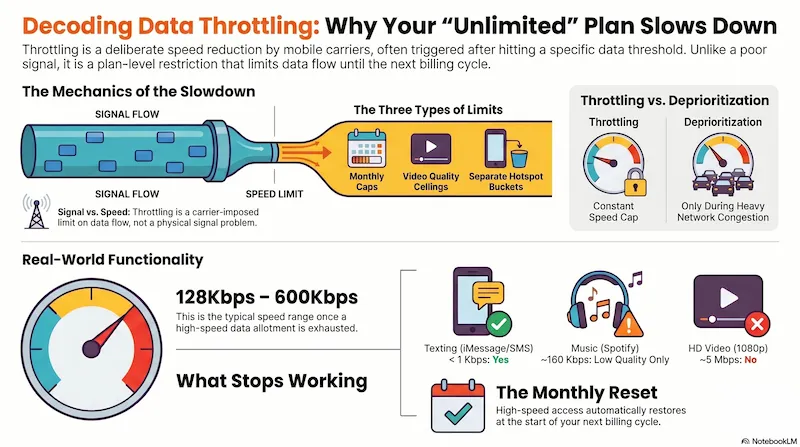
Visual summary created with NotebookLM · Research and analysis by SwitchNinja Staff.
Why carriers throttle data
Carriers throttle for two main reasons — and it helps to understand both separately, because they have different names in your plan's fine print.
1 — Data Cap Throttling
Your plan gives you a set amount of high-speed data. Once you use it, the carrier drops your speed for the rest of the month. This is the most common form — it affects basic plans and even some unlimited plans after a high-speed threshold.
2 — Video Throttling
Some carriers permanently cap video streaming speeds regardless of how much data you've used. This isn't a punishment for heavy use — it's an always-on restriction baked into the plan tier.
3 — Hotspot Throttling
Hotspot data has its own cap and its own throttle — tracked separately from your main data. After you hit the hotspot limit, hotspot speeds drop while your phone's regular data may still be at full speed.
Throttling vs. deprioritization — not the same thing
Throttling = a plan-level speed reduction triggered after you hit a usage threshold. Once it kicks in, you stay at the slower speed until your billing cycle resets — regardless of tower load.
Deprioritization = you move to the back of the line during congestion only. When a tower is busy, your data waits. When traffic clears, you're back to full speed automatically — no data cap required. See our deprioritization guide and priority data guide for the full explanation.
Speed cap = a fixed ceiling baked into the plan itself — often for video streaming or hotspot — that applies all the time, regardless of usage or congestion. Visible's 5/25Mbps plan speeds are a speed cap, not throttling in the traditional sense.
When does throttling kick in — by carrier?
Here's how each carrier handles data slowdowns on unlimited plans as of April 2026. Note: plan names and thresholds change — always verify with the carrier before purchasing.
| Carrier / Plan | High-Speed Threshold | After Threshold |
|---|---|---|
| Verizon (top tier unlimited) | No hard high-speed data cap | No post-cap slowdown; deprioritization may apply during congestion |
| Verizon (mid-tier unlimited) | Deprioritized after ~30GB | Deprioritized during congestion (not a hard throttle) |
| T-Mobile (top tier unlimited) | No hard high-speed data cap | No post-cap slowdown; may include hotspot or video policy limits |
| T-Mobile (entry unlimited) | Priority data threshold (varies by plan) | Deprioritized after threshold; verify current plan terms |
| Visible / Visible+ | No usage-based data cap | Plan-level speed ceiling (not usage throttling) — see note below table |
| Mint Mobile Unlimited | High-speed allotment (verify current plan) | Slower speeds or deprioritization after allotment |
| Tello Unlimited | High-speed allotment (verify current plan) | Reduced speeds after allotment |
| Cricket | No hard data cap (varies by plan) | Deprioritized during congestion; no hard monthly throttle |
| Metro | Priority data threshold (varies by plan) | Deprioritized after threshold |
| US Mobile (top tier) | No hard high-speed data cap | No hard throttle; deprioritization may apply during congestion |
| Straight Talk | Varies by plan | Deprioritized during congestion; check specific plan terms |
Thresholds as of April 2026. Plan names and terms change — always verify with the carrier before purchasing.
Note on Visible: Visible's plan speeds are a permanent ceiling set by the plan tier — not usage-based throttling. It's a different type of speed limit, which is why it doesn't fit cleanly in the table above.
How slow is "throttled" speed?
This is where the real-world impact becomes clear. Throttled speeds are typically between 128Kbps and 600Kbps. Here's what you can and can't do at those speeds:
| Activity | Speed needed | Works when throttled? |
|---|---|---|
| Text messages / iMessage | <1 Kbps | ✓ Yes |
| Basic web browsing | ~100 Kbps | ⚠ Barely |
| Music streaming (Spotify) | ~160 Kbps | ⚠ Low quality only |
| Native voice calls | Not data-dependent | ✓ Yes (VoIP calls via WhatsApp, Zoom, FaceTime Audio do use data and can be affected) |
| SD video streaming (480p) | ~500 Kbps | ✗ Unlikely |
| HD video streaming (1080p) | ~5 Mbps | ✗ No |
| Video calls (Zoom/FaceTime) | ~1.5 Mbps | ✗ No |
How to avoid or minimize throttling
Choose a Higher-Threshold Plan
If you regularly use 30GB+ per month, lower-tier unlimited plans will catch you. Top-tier unlimited plans from the major carriers typically have no hard monthly data cap — check plan specs before you buy.
Use Wi-Fi Whenever Possible
Wi-Fi usage doesn't count against your cellular data. At home, work, or a coffee shop — connect to Wi-Fi and save your cellular data for when you need it.
Check Usage Mid-Month
Most phones show a data usage counter in Settings. Check around the 15th to see if you're on pace to hit your threshold before month-end.
Lower Video Quality on Streaming Apps
Netflix, YouTube, and Spotify all let you cap streaming quality. Setting Netflix to "Standard" instead of "Auto" can cut data usage by 60% with minimal visible difference on a phone screen.
Frequently asked questions
Does throttling reset every month? ▼
Is throttling the same as a bad signal? ▼
Can I pay to remove throttling mid-month? ▼
Which plan has the most data before throttling? ▼
⚡ The Bottom Line
"Unlimited" doesn't always mean unlimited — check the threshold before you buy.
Most unlimited plans include a high-speed data threshold — after which speeds drop sharply. For light to moderate users (under 20GB/month), this rarely matters. For heavy users or remote workers, the threshold is one of the most important specs to compare. Don't get caught paying for "unlimited" and hitting a wall at 35GB.
See how throttling compares across carriers: read the Visible review or the US Mobile review.