Quick answer
Priority data is a network policy that gives certain plans first access to tower capacity when a cell site is congested. It does not change coverage — your phone still connects to the same towers — but it affects how your data performs when that tower is busy.
For most people in most places, congestion is rare. But in dense cities, stadiums, airports, and other crowded locations, priority can make a real difference.
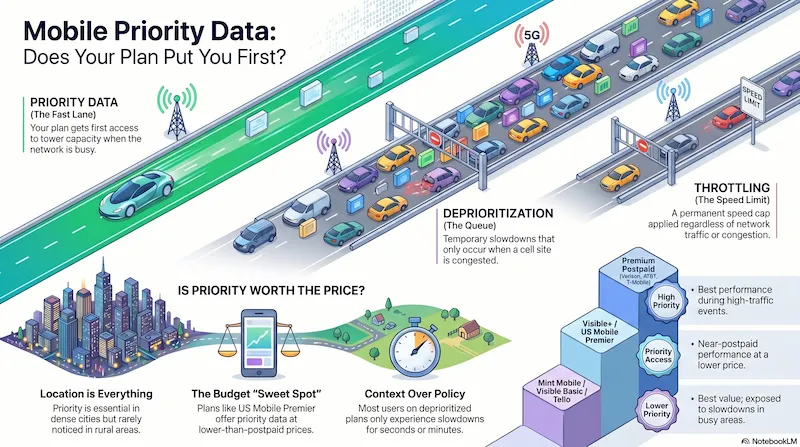
Visual summary created with NotebookLM · Research and analysis by SwitchNinja Staff.
Priority vs. deprioritization vs. throttling — what's the difference?
Three different things that affect your speed:
Priority data — Your plan gets first access to tower capacity during congestion. This reduces the chance of slowdowns but does not guarantee perfect speed at all times.
Deprioritization — Your plan is lower in the queue when a tower is busy, so speeds can drop temporarily until traffic eases. Most budget and MVNO plans work this way — usually unnoticeable outside of dense areas. Full deprioritization guide →
Throttling — A speed limit applied because of plan rules, usually after a data threshold or on specific features like hotspot. Some plans use video caps or other policy-specific limits rather than a universal speed cap. Unlike deprioritization, throttling is a plan-level limit that can apply even when the network is empty. How throttling works →
The important distinction: deprioritization is temporary and location-dependent. Throttling is a plan-level cap that applies regardless of congestion. Many plans have both.
How congestion actually works
A cell tower is like a shared highway lane with limited capacity. When few people are using it, everyone moves fast. When too many people connect at once, the carrier has to decide whose traffic gets handled first — and that decision is based on priority tier.
This isn't the carrier reducing your coverage. It's a traffic-management policy that only matters when the network is busy. The question is where your plan sits in that system.
Which plans have priority data?
Here's how the carriers SwitchNinja tracks handle priority across their plan tiers:
| Carrier / Plan | Priority Status | Notes |
|---|---|---|
| Verizon premium postpaid | High priority | Usually among the best-performing consumer options during congestion |
| Visible+ / Visible+ Pro | Priority on Verizon | Premium Visible tiers are closer to Verizon postpaid performance than Visible Basic |
| Visible Basic | Lower priority | Good value, but more likely to slow down in crowded areas |
| T-Mobile premium postpaid | High priority | Higher-end T-Mobile plans generally perform better than most MVNOs during congestion |
| Metro by T-Mobile | Lower priority | Typically lower priority than T-Mobile-branded premium plans; exact behavior varies |
| Mint Mobile | Lower priority | Usually fine for everyday use, but more exposed to slowdowns in busy areas |
| Tello | Lower priority | Best for low-cost users who can tolerate occasional congestion |
| AT&T premium postpaid | High priority | AT&T uses multiple priority tiers — exact behavior depends on the specific plan |
| Cricket Wireless | Varies by plan | Some plans are lower priority — verify the specific plan rather than generalizing |
| US Mobile Unlimited Premium / Premier | Priority on supported networks | Premium tiers include priority access; details vary by network and plan version |
Network policies as of April 2026. Always verify with the carrier before signing up.
Does deprioritization actually affect you?
Honestly, for most people: not much. Here's how to think about it:
You probably won't notice it if you: live in a suburb or rural area, rarely attend large crowded events, use Wi-Fi at home and work, or just need your phone to work reliably for calls and normal browsing.
You might notice it if you: live in a dense urban area and rely heavily on mobile data, work at events or venues with thousands of people, or need consistently fast speeds for video calls or uploading large files on the go.
The Mint Mobile user in suburban Ohio and the Visible user in Dallas probably never notice deprioritization. The same plans at a sold-out NFL game might see slowdowns. Context matters more than the policy itself.
Is priority data worth paying more for?
Priority data is usually worth paying extra only if you regularly hit congested areas and care about consistent speed. If you mostly use your phone in normal day-to-day settings, a cheaper deprioritized plan is usually the better value. Two questions help decide:
1. Do you regularly experience congestion? If you've never noticed your phone slowing down in a crowd, you're probably not in a high-congestion area enough for priority to matter.
2. What do you use your phone for? Streaming music or checking email? You'll barely notice slowdowns. Video calls or navigation at a packed event? Priority data becomes more valuable.
Frequently asked questions
Does priority data mean unlimited speed?▼
No. Priority data means you're served first during congestion — it doesn't remove speed caps or throttling. A plan can have priority data and still throttle you after 50GB. Read the full plan details to understand both policies.
Is Visible+ worth the extra cost over basic Visible?▼
If you spend time in crowded markets, cities, or events, Visible+ is a meaningful upgrade — its premium tiers are closer to Verizon postpaid performance. If you're mostly in suburban or rural areas, Visible Basic is still strong value.
Can I get priority data on a budget plan?▼
US Mobile's Premium plan includes priority data and starts around $44/month — significantly cheaper than Verizon or AT&T postpaid while still giving you priority access. It's the best middle-ground option if priority matters to you but you don't want to pay full postpaid prices.
Does priority data affect call quality?▼
Standard voice calls are handled separately from data and are rarely affected by congestion. Priority data mainly matters for internet usage — browsing, streaming, video calls over apps like Zoom or FaceTime.
If I'm on a deprioritized plan, how long does the slowdown last?▼
Usually seconds to a few minutes — as long as the tower stays congested. Once traffic clears, your speed returns to normal automatically. It's not a permanent penalty, just a temporary queue position.
⚡ The Bottom Line
Priority data matters more than carriers let on — but less than you'd think for most people.
If you're in a busy area and need reliable mobile data, priority can be worth paying for. If not, a lower-cost deprioritized plan is usually the smarter buy — the difference is often invisible on a quiet network and only shows up when lots of people are competing for the same tower.
See how priority data compares in practice: read the Visible review or the US Mobile review.