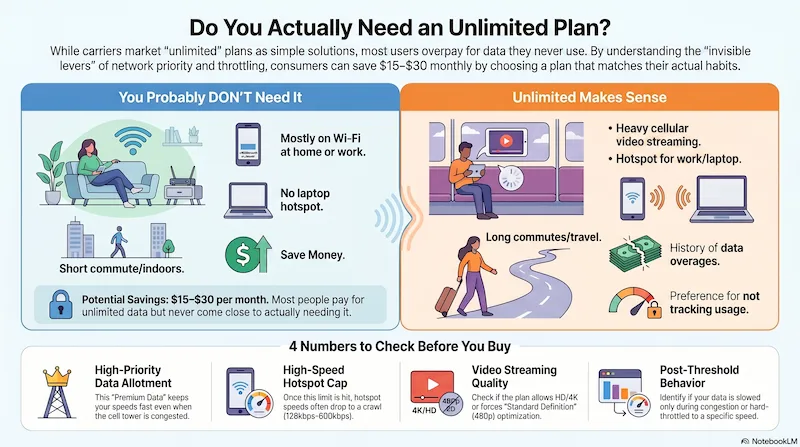
Infographic generated via NotebookLM from official carrier policy sources. Analysis by SwitchNinja Staff.
Quick answer
If you use under 10GB/month on cellular and you're mostly on Wi-Fi at home and work, you probably don't need unlimited — and you're likely overpaying by $15–$30/month. If you stream heavily on cellular, use hotspot for a laptop, or have a long commute, unlimited likely makes sense.
The bigger issue: most people don't know which camp they're in. Check your phone's data usage in Settings before your next billing cycle — that number tells you more than any plan comparison.
What "unlimited" actually includes
At the most basic level, every unlimited plan gives you unlimited talk and unlimited text. Data is where it gets complicated. Most plans also include a large bucket of data for your phone — but "a lot of data" and "full-speed data all the time" aren't the same thing.
Carriers use "unlimited" because it's simple, emotional, and easy to sell. The word is technically accurate — you can keep using data, you won't be charged extra. But behind that word are three invisible levers that control your actual experience: priority, throttling, and service caps.
The three levers carriers use to manage "unlimited"
Lever 1 — Network Priority
Who gets fast data when the tower is busy
Every carrier splits its unlimited plans into priority tiers. Premium unlimited plans give you a set amount of "priority" or "premium" data — while you're within that allotment, you get served first on a congested tower. Basic unlimited plans are often deprioritized at all times, meaning other users jump the queue ahead of you during busy periods. On an empty tower this makes no difference. At a stadium or downtown during rush hour, the gap is very noticeable. How deprioritization actually works →
Lever 2 — Throttling
A hard speed cap, regardless of network conditions
Throttling is different from deprioritization. Deprioritization only slows you when the tower is congested. Throttling is a permanent speed cap the carrier applies after you hit a threshold — often to your hotspot data — that stays in place even on an empty tower. Hotspot is commonly throttled to 128kbps–600kbps after the high-speed cap runs out, which is too slow for most practical use. Throttling vs. deprioritization explained →
Lever 3 — Service Caps
Hard limits on specific features, even when data is "unlimited"
Hotspot, video streaming quality, and international data are the most common features with separate caps — even on plans where your phone data is genuinely unlimited. These aren't buried loopholes; they're standard across nearly every carrier's unlimited lineup, including the major ones.
Three features that often come with hidden limits
Mobile Hotspot
Almost never unlimitedYour phone data may be unlimited, but hotspot data commonly has its own separate cap — often 10GB–50GB at high speed depending on plan tier, though some premium plans offer more generous terms. Once you hit the high-speed cap, hotspot is typically throttled to very slow speeds (often around 128kbps–600kbps) for the rest of the billing cycle — fast enough for basic messaging but too slow for browsing, video calls, or laptop use.
This is the single biggest gap between how people imagine "unlimited" and what they actually get. If you rely on your phone as a mobile hotspot for a laptop or tablet, the hotspot data cap is the most important number to check. How mobile hotspot works →
Video Streaming Quality
Varies by tierMany unlimited plans use "Video Optimization" or "Stream Saver" — the carrier detects when you're watching video and limits the connection speed, often resulting in standard definition playback rather than HD or 4K. Exact speed caps vary by carrier and plan. This typically happens automatically on base unlimited tiers to manage network load.
You won't run out of data watching video — but you may be watching in lower quality whether you want to or not. Premium unlimited tiers typically allow HD or 4K streaming. On a phone screen the difference is often hard to notice, but on a TV via Chromecast or Apple TV, it's visible.
International / Roaming Data
Usually 2G speeds only"Unlimited international data" on many plans means very slow speeds abroad — often around 2G — which is enough for maps, messaging, and basic browsing, but not for social media video or video calls. Terms vary by carrier and plan. High-speed international data typically costs extra or requires upgrading to a travel day pass.
"Unlimited" also generally applies only to the carrier's home network. Roaming domestically in areas your carrier doesn't cover natively may trigger separate roaming limits even on an unlimited plan. How roaming works →
Basic unlimited vs. premium unlimited — the real difference
"Unlimited" isn't one thing — most carriers offer multiple tiers under the unlimited label, ranging from budget to premium. The differences matter most in congested areas and for hotspot users:
| Feature | Basic Unlimited | Premium Unlimited |
|---|---|---|
| Data priority | Deprioritized at all times | High-priority data (often 50GB–100GB+) before deprioritization |
| Hotspot | Minimal or none (often 5–15GB then throttled) | More high-speed hotspot (often 30–60GB+) |
| Video streaming | Often capped at 480p–720p | HD or 4K allowed |
| International data | 2G speeds | Higher speeds or included day passes |
| Monthly price (single line) | $50–$70/mo | $80–$100/mo |
Illustrative ranges — exact features and pricing vary by carrier, plan, and promotions.
The four numbers to check before buying any unlimited plan
Skip the word "unlimited." Look for these instead:
How much high-priority (or premium) data do you get?
Example: "50GB of Premium Data." This is what keeps you fast on a congested tower. If the plan doesn't list a number, it may be deprioritized from the start.
How much high-speed hotspot data is included?
Example: "15GB High-Speed Hotspot, then reduced speeds." If you use hotspot for a laptop, this number matters more than any other on the plan.
What video quality does the plan allow?
Look for "HD streaming" or "4K streaming" as a listed feature. If the plan says "Standard Definition" or mentions "Video Optimization," expect 480p–720p by default.
What happens to your data after the priority threshold?
Look for the phrase "may be slowed during times of congestion" or "deprioritized after X GB." This tells you whether there's a hard cap or just a congestion-based slowdown.
Do you actually need an unlimited plan?
You probably don't need unlimited
✓ Mostly on Wi-Fi at home and work
✓ Use under 10GB/month on cellular
✓ Short commute or mostly indoors
✓ Don't use hotspot for a laptop
✓ Want to save $15–$30/month
Unlimited likely makes sense
› Stream video heavily on cellular
› Long commutes or frequent travel
› Use hotspot for work or a laptop
› Don't want to track data usage
› Hit overages on capped plans before
💡 The MVNO angle
MVNOs like Mint Mobile, Visible, and US Mobile offer unlimited plans on the same Verizon, T-Mobile, and AT&T networks for $25–$45/month — a fraction of what the big carriers charge for their premium unlimited tiers. The trade-off is often less priority data and lower hotspot caps, which is fine for most light-to-moderate users. If you don't need the full premium tier, an MVNO unlimited plan is frequently the smartest call. What is an MVNO? →
Frequently asked questions
What does unlimited mean on a cell phone plan?▼
Unlimited means you won't get charged overage fees for using too much data. It does not mean you'll always get full speeds. Most unlimited plans include limits on hotspot data, video streaming quality, and data priority during network congestion — all hidden in the fine print.
Is unlimited data really unlimited?▼
Technically yes — you can keep using data. But speed and priority are not unlimited. After a certain amount of usage, many plans slow your hotspot to near-useless speeds, cap video to standard definition, or deprioritize your connection when towers are busy.
What is the difference between basic and premium unlimited plans?▼
Basic unlimited plans are often deprioritized at all times, meaning your data slows down whenever the tower is busy. Premium unlimited plans include a set amount of high-priority data before deprioritization can apply, more hotspot data, and often HD or 4K video streaming. The gap in real-world experience can be significant in congested areas.
Do I actually need an unlimited plan?▼
Many people don't. If you're mostly on Wi-Fi at home and work, a capped data plan at a lower price tier often covers everything you need. Unlimited plans make the most sense for heavy data users, frequent commuters, hotspot users, and people who want to avoid ever thinking about data usage.
⚡ The Bottom Line
"Unlimited" is a marketing word. The four numbers above are the real plan.
Before buying any unlimited plan, ignore the word unlimited and find: your priority data allotment, your high-speed hotspot cap, your video streaming limit, and what happens after the priority threshold. Those four things tell you more about your actual experience than the word "unlimited" ever will.
If a plan is expensive but still has a small hotspot cap or always-on deprioritization, it may not be meaningfully better than a cheaper prepaid option. For many people, a lower-cost MVNO unlimited plan covers everything they actually need.
Compare unlimited plans side by side: see our Verizon vs T-Mobile comparison or read the Visible review for a budget unlimited option.