Quick answer
- T-Mobile — best nationwide 5G experience for most users. Leads on 5G speed and availability.
- Verizon — best for reliability and consistency in recent testing (RootMetrics 7 national awards, 2026). Strong in dense urban areas.
- AT&T — widest geographic footprint. Fewest dead zones, strong call performance. Some plans offer stronger international options for travelers.
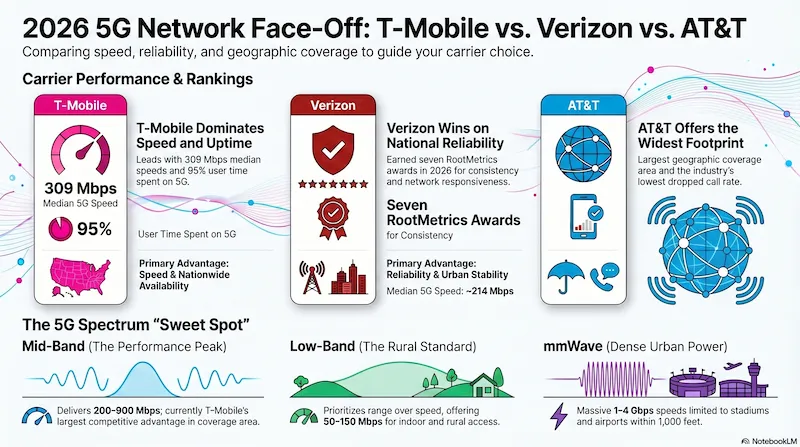
Visual summary created with NotebookLM · Research and analysis by SwitchNinja Staff.
| Carrier | Median 5G Download | Strength |
|---|---|---|
| T-Mobile | ~309 Mbps | Nationwide coverage + low latency |
| Verizon | ~214 Mbps | Peak city speeds + connection stability |
| AT&T | ~172 Mbps | South & Southeast, expanding fast |
Source: Ookla Speedtest Intelligence, Q1 2026 median 5G download speeds (nationwide).
First, understand that "5G" means three different things
Not all 5G is equal. There are three types, and each carrier uses a different mix:
Low-band 5G (sub-6 GHz, below 1 GHz). Wide coverage, reaches rural areas and indoors easily. Speeds are only marginally faster than 4G LTE — think 50–150 Mbps. All three carriers have this, and it's what most people mean when they see a "5G" icon on their phone in a non-city area.
Mid-band 5G (2.5 GHz, C-band). The sweet spot. Strong speeds (200–900 Mbps) with reasonable coverage range. This is where the real competition is. T-Mobile has the largest mid-band footprint by far, built on spectrum it acquired through the Sprint merger. Verizon and AT&T are actively expanding mid-band coverage throughout 2026.
mmWave 5G (24–47 GHz). Blazing fast — 1–4 Gbps peak speeds — but only reaches about 1,000 feet from the tower and can't penetrate walls. Only useful in dense urban environments: stadiums, airports, convention centers. Verizon has the most mmWave deployment. For most users, mmWave is irrelevant day-to-day.
T-Mobile: best overall 5G experience
T-Mobile's mid-band 5G covers over 300 million people — more than Verizon and AT&T combined on mid-band. This is the result of the 2020 Sprint merger, which gave T-Mobile access to 2.5 GHz spectrum that took years to build out but is now its biggest competitive advantage.
For the average user — suburban, small city, or traveling between metros — T-Mobile delivers the most consistently fast 5G experience. The numbers back it up: Ookla named T-Mobile the fastest network in America for the 14th consecutive quarter in Q1 2026, with a median download speed of ~249 Mbps — roughly 65 Mbps faster than Verizon or AT&T. Opensignal's January 2026 report awarded T-Mobile 12 out of 16 total awards, including a sweep of all five Overall Experience categories. Users also spend significantly more time actually on 5G: T-Mobile subscribers are connected to a 5G signal approximately 95% of the time, compared to competitors who regularly drop back to 4G LTE in suburban and indoor environments.
There's also an under-the-hood advantage: T-Mobile's network is almost entirely built on 5G Standalone (SA) architecture — a newer design that removes the 4G LTE dependency. The practical benefits: noticeably lower latency (ping) for gamers, faster call connections through VoNR (Voice over New Radio), and more responsive real-time video. If you game or do frequent video calls on your phone, you'll feel the difference over a non-SA network.
Verizon: strongest for reliability in recent testing
Verizon's C-band (mid-band) rollout has been aggressive since 2022, and its mmWave deployment in dense urban venues delivers strong peak speeds where it's available. Where Verizon pulls ahead of T-Mobile in many tests is not speed — it's reliability. In the most recent RootMetrics report, Verizon took seven national awards including Overall Performance, Network Reliability, and Network Responsiveness. J.D. Power also ranked Verizon highest for fewest network problems per 100 uses. These results reflect a snapshot in time and may vary by location and reporting period.
Where T-Mobile still leads: raw 5G download speeds, particularly in cities where its mid-band footprint is densest. If you're a heavy data user in a major metro and peak speed is your priority, T-Mobile has the edge. But if your priority is "it just works" — reliable calls, consistent data, no dropped connections in buildings or between cities — Verizon wins that comparison in 2026. The distinction is peak speed versus everyday reliability, and they don't always point to the same carrier.
One area where Verizon's mmWave pays off beyond just mobile: it powers Verizon's 5G Home Internet in dense city areas, where it frequently delivers speeds faster than cable. If you're evaluating Verizon for home internet rather than your phone plan, that's a different conversation — and mmWave is the reason it works.
AT&T: widest geographic footprint and strong call performance
AT&T's strategy in 2026 isn't about winning speed tests — it's about having signal everywhere and dropping no calls. The results: Opensignal awarded AT&T the "Time on Network" title for the fourth consecutive year, with users spending 99.6% of their time on a 3G or better connection — the highest score in the industry and a direct measure of dead zones. RootMetrics separately named AT&T the winner for Best Call Performance, with the lowest dropped call rate in America for 2026.
The geographic footprint advantage is significant: AT&T's coverage area is roughly 300,000 square miles wider than T-Mobile's by some estimates. The reason is FirstNet — AT&T holds the federal contract to build and manage the dedicated network for first responders, which required tower builds in rural areas where no carrier would invest purely on commercial returns. Commercial AT&T customers benefit from that infrastructure directly. In early 2026, AT&T also completed deployment of 3.45 GHz mid-band spectrum across 5,300+ cities — an 80% capacity boost that now delivers a stable 150–200 Mbps in most suburban areas. The speed gap with T-Mobile remains, but it's no longer a practical limitation for everyday use.
One plan-level advantage worth noting: certain AT&T plans include high-speed data in Mexico and other Latin American countries at no extra charge, compared to other carriers that throttle or charge daily roaming fees. This is a plan-specific feature — not universal across all AT&T plans — so verify what's included before you commit. For frequent travelers to Mexico or Central America, it can be a meaningful differentiator. Its MVNO Cricket Wireless offers the same AT&T network at a lower price for domestic users.
The catch the data doesn't show: AT&T's pricing is the least flexible of the three. Entry plans are more restrictive, and they're slower to discount for existing customers. If coverage and call reliability are your priorities and you're in a region where AT&T is strong, the network itself justifies it. If you're primarily price-sensitive, their MVNO Cricket Wireless delivers the same towers at a fraction of the cost.
What about satellite backup?
Both T-Mobile and Verizon now offer satellite-assisted connectivity for when you're completely out of cell range. T-Mobile's T-Satellite (via SpaceX Starlink) provides texting and basic data. Verizon's Skylo integration covers emergency messaging only. Neither replaces traditional 5G — they're a last-resort safety net for remote areas. If satellite backup matters to you, T-Mobile's offering is broader.
⚡ The Bottom Line
For most people in most places: T-Mobile wins on 5G.
But the most important thing you can do is check the actual coverage map for your specific address — not a national ranking. A carrier that ranks #3 nationally might have a tower right outside your house. Use the official coverage maps on each carrier's website, then decide.
Check official coverage maps for all carriers →Want the full breakdown on the 5G leader? Read the T-Mobile review.