Quick answer
A SIM card (Subscriber Identity Module) is a small removable chip that stores your carrier identity. When you insert it into a phone, the carrier recognizes you on their network and activates your plan — calls, texts, and data all flow through it.
SIM cards don't store your photos, apps, or contacts (those live on your phone). They store only what the carrier needs: your account ID, phone number assignment, and authentication credentials. Swap the SIM into a compatible unlocked phone and your carrier line goes with it — though the receiving phone still needs to support your carrier's network.
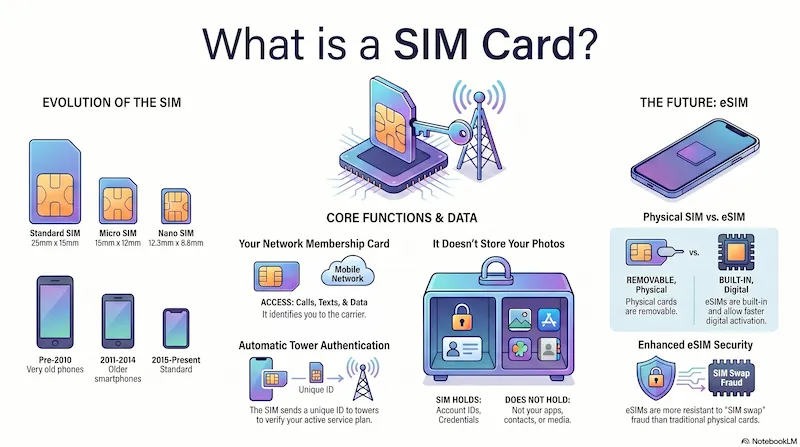
Infographic generated via NotebookLM from official carrier policy sources. Analysis by SwitchNinja Staff.
What a SIM card actually does
Think of a SIM card as your membership card for a carrier's network. The carrier's towers are the gym — your SIM is what proves you're a member allowed to use them.
When your phone connects to a tower, the tower asks: "Who are you?" Your SIM responds with a unique identifier (called an IMSI). The carrier checks that against their database, confirms you have an active plan, and grants access. This happens automatically every time your phone connects to a new tower — which can happen dozens of times as you move around.
Without a SIM (or eSIM), your phone can only call 911 — emergency services are accessible even without carrier authentication.
SIM card sizes — Standard, Micro, Nano, and eSIM
SIM cards have shrunk dramatically over the years. The electrical contacts are standardized, but different SIM formats involve different card sizes and packaging. Modern phones use Nano SIM, and most new phones are moving to eSIM entirely.
| Type | Size | Used in |
|---|---|---|
| Standard SIM | 25mm × 15mm | Very old phones (pre-2010) |
| Micro SIM | 15mm × 12mm | Older smartphones (2011–2014) |
| Nano SIM | 12.3mm × 8.8mm | Most phones today (2015–present) |
| eSIM | Built into phone | US iPhone 14+ (eSIM-only in US market), newer Androids |
iPhone 14 and newer US models have no SIM tray
Apple removed the physical SIM slot from US iPhones starting with iPhone 14 in 2022 (note: iPhone 14 models sold outside the US still include a physical SIM slot). If you have a US iPhone 14 or newer, you use eSIM only — there's no slot to insert a physical card. The carriers SwitchNinja tracks generally support eSIM on compatible devices, so this doesn't limit your options. See our full eSIM guide →
When do you actually need a new SIM card?
Most people rarely need to think about their SIM. Here are the situations where it actually matters:
Switching carriers. When you move to a new carrier, they issue you a new SIM card with your plan attached. If you're switching via eSIM, you just download the new carrier profile — no physical card needed.
Getting a new phone. If your old and new phones use different SIM sizes, you'll need a new card from your carrier. This is less common now that Nano SIM is universal, but still happens with older phones.
Your SIM is damaged or lost. A carrier can issue a replacement SIM that restores your number to a new card. This is free or low-cost at most carriers.
Traveling internationally. You might get a local SIM in the country you're visiting for cheaper local rates. eSIM makes this much easier — just download a local carrier profile without removing your home SIM.
Your phone is SIM-locked. If you bought your phone directly from a carrier (not from Apple, Google, or Samsung), it may be locked to that carrier's SIM. Unlock policies vary by carrier and device eligibility — contact your carrier to check your device's status. Many carriers unlock eligible phones at no charge once requirements are met.
SIM card vs. eSIM — which should you use?
If your phone supports both, eSIM is the better choice for most people. It activates faster, can't be physically lost or damaged, is more secure against SIM swap fraud, and lets you store multiple carrier profiles.
Physical SIM cards still make sense if you have an older phone that doesn't support eSIM, or if you're in a country where eSIM carrier support is limited. In the US, the carriers SwitchNinja tracks generally support eSIM on compatible devices.
Frequently asked questions
Does removing a SIM card erase my phone data?▼
No. Your photos, apps, contacts, and files are stored on your phone's internal memory — not on the SIM card. Removing or swapping a SIM only changes which carrier your phone connects to. Nothing else on your phone is affected.
Can I use any SIM card in my phone?▼
Only if your phone is unlocked. Carrier-locked phones only accept SIMs from the carrier they were purchased through. Unlocked phones — including all phones bought directly from Apple, Google, or Samsung — accept any compatible SIM from any carrier.
What is a SIM swap attack?▼
A SIM swap attack is when a fraudster convinces your carrier to transfer your phone number to a SIM card they control. Once they have your number, they can intercept two-factor authentication codes and break into accounts. eSIM is more resistant to this attack because transfers require account authentication — not just a social engineering call to customer service.
How do I know what SIM size my phone needs?▼
Search "[your phone model] SIM size" — it's always listed in the official specs. Almost all phones made after 2015 use Nano SIM. If you're not sure, your carrier can tell you when you pick up or order a new SIM.
Is a SIM card free when I switch carriers?▼
Usually yes for eSIM — it's a digital download with no cost. For physical SIM cards, most carriers ship them free or include them in the plan activation. Some carriers charge a small one-time activation fee ($5–$10), though many have eliminated this. Check before you sign up.
⚡ The Bottom Line
SIM cards are simple — but it helps to know whether your phone is locked or unlocked.
If your phone is unlocked, you can use any carrier's SIM or eSIM and switch freely. If it's locked, contact your carrier to check unlock eligibility — many carriers unlock eligible devices at no charge once requirements are met. Once unlocked, switching SIMs becomes much easier. Most of the value of understanding SIM cards comes from knowing you have the freedom to switch.
Once unlocked, compare your options: read the Mint Mobile review or the Visible review.