Quick answer
5G is the fifth generation of cellular network technology. It's faster and has lower latency than LTE (4G) — but LTE is still fast enough for streaming HD video, video calls, and most everyday phone tasks. The practical difference is often modest for most users in 2026.
5G matters most in dense cities where towers are congested. In some suburban and rural areas, 5G may be less available or only slightly faster than LTE. Don't choose a carrier based on 5G alone without first checking coverage and congestion in your specific area.
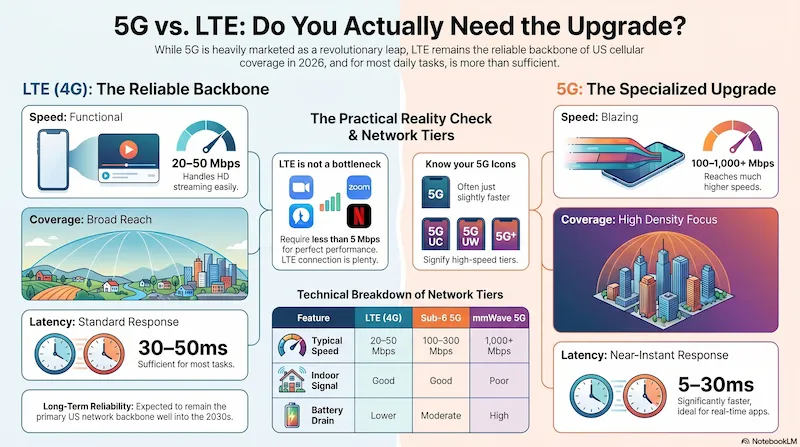
Visual summary created with NotebookLM · Research and analysis by SwitchNinja Staff.
What is LTE (4G)?
LTE stands for Long-Term Evolution — the fourth generation of cellular technology that became the standard across the US starting around 2010. By 2020, LTE coverage reached over 99% of the US population — a population coverage figure, meaning that the majority of Americans have access, though signal quality and speeds still vary by location and congestion.
LTE delivers typical download speeds of 20–50 Mbps in real-world conditions. That's more than fast enough to stream HD Netflix (5 Mbps needed), run Zoom calls (1.5 Mbps), or browse any website. For the vast majority of phone usage, LTE is not a bottleneck.
Even in 2026, LTE remains the primary connection type for most Americans — especially in rural and suburban areas where 5G is still limited.
What is 5G?
5G is the fifth generation of cellular technology, deployed in the US starting around 2019. It comes in two main types — and the difference between them is significant:
Two very different kinds of 5G:
Sub-6GHz 5G (low/mid-band): Covers large areas, penetrates buildings well. Speeds are 2–4x faster than LTE — typically 100–300 Mbps. This is what most people experience as "5G" on T-Mobile and AT&T. Coverage is wide but speed gains are moderate.
mmWave 5G (ultra-wideband): Extremely fast — up to 1–4 Gbps — but very short range and poor building penetration. Still relatively limited compared to sub-6 5G, available mainly in dense urban areas and specific venues (stadiums, airports). Verizon's "Ultra Wideband" brand includes both mmWave and C-band spectrum, so UWB doesn't always mean the fastest tier. Fast when you're in range, rare in everyday use.
5G vs LTE — side by side
| LTE (4G) | Sub-6 5G | mmWave 5G | |
|---|---|---|---|
| Typical speed | 20–50 Mbps | 100–300 Mbps | 1,000+ Mbps |
| Coverage | Nationwide (99%+) | Most cities + suburbs | Dense urban only |
| Indoor penetration | Good | Good | Poor |
| Latency | 30–50ms | 10–30ms | <5ms |
| Battery impact | Lower drain | Moderate | High drain |
| Enough for streaming? | Yes | Yes | Yes |
Which carriers have the best 5G in 2026?
5G coverage and speed vary significantly by carrier — and by which type of 5G you're comparing:
| Carrier | 5G Strength | Notes |
|---|---|---|
| T-Mobile | Strong mid-band 5G footprint | Often the best mix of 5G availability and speed; "best overall" varies by city and conditions |
| Verizon | Strong urban and C-band 5G | Fastest in dense areas where Ultra Wideband (mmWave + C-band) is available; C-Band expanding nationally |
| AT&T | Strong, balanced 5G | Good urban/suburban coverage and improving mid-band reach; FirstNet spectrum adds capacity |
| Mint / Metro / Tello | Same underlying network as T-Mobile | Same geographic 5G footprint as T-Mobile; real-world experience can still vary by plan priority |
| Visible | Same underlying network as Verizon | Coverage follows Verizon's 5G footprint; plan-level rules may still affect experience |
| US Mobile | Network of choice | Pick Verizon, T-Mobile, or AT&T — performance depends on the network selected for your line |
Does 5G matter for your plan decision?
For most people in 2026 — not significantly. Here's the honest breakdown:
You live in a major city, have a 5G phone, and regularly do bandwidth-intensive things on cellular — large file downloads, mobile gaming, high-quality video calls. The speed improvement is real and noticeable in these scenarios.
You're in a suburban or rural area (LTE is often your primary connection regardless), you mostly use Wi-Fi at home and work, or your main activities are calling, texting, and social media browsing. LTE handles all of these fine.
Frequently asked questions
Does my phone need to support 5G to use it? ▼
Why does my phone show "5G" but feel slow? ▼
Does 5G drain my battery faster? ▼
Will LTE be shut down soon? ▼
⚡ The Bottom Line
LTE is still perfectly capable — 5G is a nice upgrade, not a necessity.
Don't pay more for a plan just because it says "5G." Every plan from every carrier includes 5G where available on their network — there's no separate 5G plan tier at most carriers. The better question when choosing a plan is coverage in your area, data limits, and price — not which generation of network it runs on. See the top-ranked plans for 2026 →
Choosing between the big 3 on 5G? See our Verizon vs T-Mobile comparison or read the T-Mobile review.