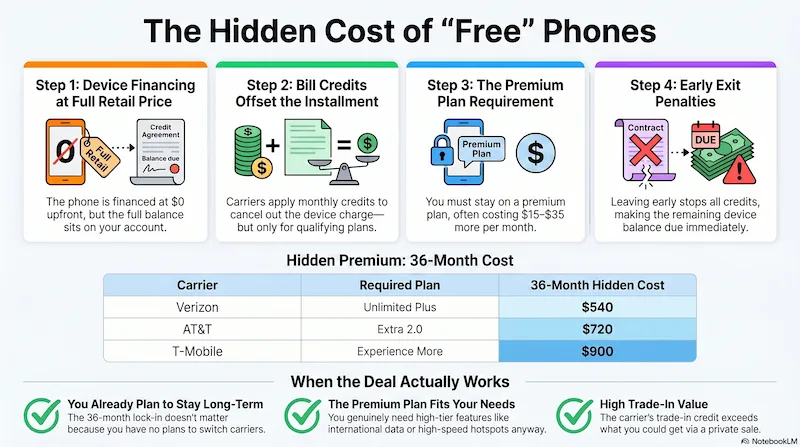
Infographic generated via NotebookLM from official carrier policy sources. Analysis by SwitchNinja Staff.
This article explains how carrier device promotions generally work. Specific offers, credit amounts, and qualifying plans change frequently — always verify current terms directly with the carrier before signing up. SwitchNinja is not responsible for any billing charges or forfeited credits. See our Terms of Use.
Quick answer
The "free" phone is not a gift — it's a device financed at full retail price ($800–$1,000+) and paid off through monthly bill credits over 24–36 months. To receive those credits you must stay on a qualifying premium plan for the entire term. Downgrade your plan, cancel your line, or switch carriers and the credits stop immediately — while your obligation to pay the remaining device balance often does not.
By the time you add up the plan premium you wouldn't have otherwise chosen, the deal is rarely as free as it looks.
How the deal actually works
When a carrier advertises "Get iPhone 16 free," here's the actual structure behind that offer:
Step 1 — Device financing
The phone is financed at full retail price (say $799). You pay $0 upfront, but the balance appears on your account as a device installment — typically $22/mo over 36 months.
Step 2 — Bill credits offset the installment
The carrier applies a matching promotional credit each month — also $22 — which cancels out the device charge. Net cost on your bill: $0 for the phone. This is the "free" part. But those credits only flow if you stay on a qualifying plan.
Step 3 — The plan requirement
To receive the credits, you must stay on a mid-tier or premium unlimited plan — not the carrier's basic option. This is where the real cost hides. The plan you're required to be on is $15–35/mo more than the plan you might have chosen otherwise.
Step 4 — Leave early and you owe both
Switch carriers or cancel before the 36 months are up? The bill credits stop immediately. The remaining device balance does not. You may owe several hundred dollars — and you've already lost your trade-in phone. What leaving actually costs →
The real math: what you actually pay
Here's a realistic example using a $799 phone and a 36-month promo on a single line. The device credits are real — the plan premium is the hidden cost most people don't factor in.
| Carrier | Required plan | Entry plan | Premium over 36 mo |
|---|---|---|---|
| Verizon | Unlimited Plus ($70/mo) | Unlimited Welcome ($55/mo) | $540 |
| AT&T | Extra 2.0 ($70/mo) | Value 2.0 ($50/mo) | $720 |
| T-Mobile | Experience More ($85/mo) | Essentials ($60/mo) | $900 |
Plan prices with AutoPay. Premium = required plan minus entry plan × 36 months. Verify qualifying plans at each carrier before signing up.
⚠ The takeaway
The "free" $799 phone can cost you $540–$900 in plan premiums over 36 months — before taxes, fees, or insurance.
That's on top of whatever you would have paid for service anyway. The phone wasn't free. You financed it through a more expensive plan.
The trade-in layer: your old phone funds part of it
Most "free phone" promos require you to trade in your current device. The carrier assigns your old phone a trade-in value — sometimes matching or exceeding market value, sometimes not — and applies it as part of the promotional credit stack. A few things worth knowing:
- You give up your old phone immediately. Once it's traded in, it's gone. If the deal falls through or your new line is cancelled, you typically don't get it back.
- Private sale value is often higher. For phones in good condition, selling on Swappa or Facebook Marketplace frequently yields more cash than a carrier trade-in. That cash could go toward an unlocked phone with no strings attached.
- Trade-in values require good condition. Cracked screens, water damage, or missing accessories can drop the trade-in value significantly — sometimes enough to void the "free" threshold entirely.
- Some promos require a new line. Existing customers upgrading a current line may get a lower credit than new customers adding a fresh line. Always confirm which scenario you fall into.
BOGO deals: the two-line version of the same trap
"Buy one iPhone, get one free" — BOGO promotions work identically to single-line free-phone deals, with one added catch: both lines must stay active for the full promotional period. Cancel either line and the credits for both may stop.
Common BOGO scenario
A couple signs up together: two new lines, two "free" iPhones, both on premium unlimited plans. Two years later they break up. One person wants to cancel their line and switch to a cheaper carrier. Cancelling their line can void the BOGO credit on the other person's phone — leaving the remaining partner holding a device balance they thought was settled.
The safest BOGO is one where both lines belong to people with zero plans to separate accounts for 3 years. That's a smaller group than the ads assume.
When the deal actually works in your favor
The deal is legitimately good under a specific set of conditions — and they all have to be true at the same time:
✓ You were already going to stay
You've been with this carrier for years and have no plans to leave. The plan lock-in doesn't cost you anything because you weren't going anywhere anyway.
✓ The required plan is what you'd choose
You genuinely need the features of the mid or premium tier — substantial hotspot, 5G Ultra Wideband, international data — and you'd be on that plan regardless.
✓ The credit beats private sale value
Your old phone's trade-in value at the carrier matches or exceeds what you'd realistically get selling it yourself — rare, but it happens on older models.
If all three boxes are checked, the deal is real and worth taking. Most people signing up from a TV ad check zero of them.
The alternative: buy unlocked, skip the trap
Buying an unlocked phone outright — directly from Apple, Samsung, or Google — removes every part of the trap. You own the phone, you choose the plan, you can leave any time. The upfront cost feels higher, but the total cost of ownership often isn't.
| Scenario | Phone cost | 36-month plan cost | Total |
|---|---|---|---|
| "Free" iPhone on Verizon Plus | $0 upfront | $2,880 (36 × $80) | $2,880+ |
| Unlocked iPhone + Visible | $799 upfront | $900 (36 × $25) | $1,699 |
| Unlocked iPhone + US Mobile Starter | $799 upfront | $900 (36 × $25) | $1,699 |
Estimates. Taxes, fees, and insurance not included. MVNO plans use Verizon's network — though data priority may differ during congestion. Verify current prices before switching.
The unlocked path saves over $1,100 over 3 years — even after paying full price for the phone. You can leave any time, downgrade your plan if your needs change, and your phone works on any carrier globally. The "free" phone deal locks you in for three years and saves you less money than it appears.
⚡ SwitchNinja take
The free phone got you in the door. The plan is how they make it back.
Carrier "free phone" deals are not scams — the bill credits are real and the math works if you were already planning to stay on a premium plan for three years. But the ads are designed to make you feel like you're getting a windfall, not signing a 36-month financing agreement tied to a more expensive plan.
Before you sign: check what plan tier is required, calculate the premium cost over 36 months, compare that to what you'd pay buying unlocked and going prepaid, and decide if the locked-in savings are actually savings. For most people responding to a mass-market ad, the math doesn't favor the deal.
Common questions
Can I keep my free phone if I switch carriers early?
Yes — the phone is yours. But the remaining device installment balance becomes immediately due, and your promotional bill credits stop. You end up paying full retail price for the phone plus whatever service you used.
What happens if I downgrade my plan?
You can downgrade, but if your new plan doesn't qualify for the promotion, the monthly bill credits typically stop. Read the fine print on your specific offer — qualifying plan tiers are spelled out in the promotion terms.
Do free phone deals require good credit?
Postpaid plans from Verizon, AT&T, and T-Mobile typically require a credit check. The device installment is essentially a financing agreement — carriers run credit before approving you for a phone on a payment plan.
Is buying an unlocked phone actually cheaper?
Over 36 months, yes — typically by $1,000 or more when you pair an unlocked phone with a prepaid MVNO. The upfront cost is higher, but the monthly savings more than offset it. The math is in the table above.
Want to see how the carriers compare without the device deal math? Read our Verizon vs T-Mobile comparison or the Verizon review for a full breakdown of what you get on each plan tier.