Quick answer
A family plan is one account with multiple phone lines billed together. Each line gets its own number and data allotment, but everyone shares a discounted rate. Many carriers lower the per-line price as you add more lines — often resulting in $20–$35/line vs. $50+ on a solo plan, depending on the carrier and tier.
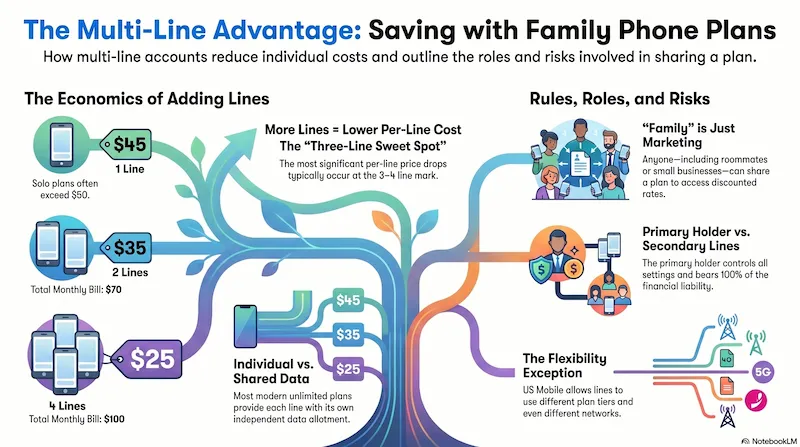
Infographic generated via NotebookLM from official carrier policy sources. Analysis by SwitchNinja Staff.
What "family plan" actually means
The word "family" is marketing. These are really multi-line accounts — and the lines don't have to be family members. Roommates, couples, small businesses — anyone can share a plan as long as someone agrees to be the account holder.
The account holder is responsible for the bill. Other lines are typically called "additional lines" or "secondary lines." They can use the phone normally but usually can't make account changes without the primary holder's permission.
How pricing works: the more lines, the less each costs
Many carriers discount each line as you add more. Here's how multi-line pricing typically scales — the exact numbers vary by carrier and plan tier, but the pattern is consistent:
| Lines on Account | Price Per Line/Mo | Total Bill |
|---|---|---|
| 1 line | $45 | $45 |
| 2 lines | $35 | $70 |
| 3 lines | $30 | $90 |
| 4 lines | $25 | $100 |
The per-line rate drops noticeably at 3–4 lines. On major postpaid carriers like T-Mobile, Verizon, and AT&T the savings at 4+ lines can be even more significant, though the base plan prices start higher. Always compare at the line count you actually need.
Shared data vs. individual data per line
This is where people get confused. There are two models:
Individual Data Per Line — Most Common
Each line gets its own allotment — one person burning through data doesn't affect anyone else. This is the standard model on modern unlimited plans across most carriers.
Shared Data Pool
All lines pull from one data bucket. Helpful when usage is uneven, but risky if someone consistently overuses. Most current unlimited family plans use individual per-line data rather than a pooled bucket.
Know before you add lines
On unlimited plans, "unlimited" still means your data can be deprioritized during congestion after a threshold (typically 25–50 GB). Each line's priority level, hotspot cap, and data rules are determined by its own plan tier — not simply by which line pays the least. If lines on the account are on different tiers, the plan terms for each line apply independently.
Who controls the account?
The primary account holder controls everything: adding/removing lines, upgrading plans, making payments, and managing account settings.
Secondary Lines Can
- Use the phone normally (calls, texts, data)
- Set their own voicemail and device settings
- Contact support for basic troubleshooting
Secondary Lines Cannot
Change the plan tier, add lines, or see the full bill without the primary holder's permission.
Family plan pricing by carrier (2026)
| Carrier | 4-Line Price/Mo | Notes |
|---|---|---|
| T-Mobile | Multi-line unlimited pricing | Strong discounts at 3+ lines; verify current plan pricing |
| Verizon | Multi-line unlimited pricing | Line-count discounts; taxes/fees vary by plan; autopay required |
| AT&T | Multi-line unlimited pricing | Tiered pricing with meaningful savings at 3–4 lines |
| Mint Mobile | Prepaid annual-style pricing | Good low-cost per line; not a classic shared family plan — each line managed separately |
| US Mobile | Flexible multi-line pricing | Mix-and-match plans per line is a key differentiator |
| Metro by T-Mobile | Prepaid multi-line pricing | Often lower cost; taxes typically included; terms vary by plan |
| Visible | Single-line focus | Not a traditional multi-line family plan for new users; prior Party Pay model discontinued |
US Mobile advantage
US Mobile lets each line on an account run a different plan — even on different networks (T-Mobile or Verizon). Most carriers require all lines to use the same tier. Great if one person needs lots of data and another barely uses any.
Potential downsides of family plans
Bill Responsibility
The primary account holder is liable for the entire bill regardless of who uses what. If a secondary line doesn't contribute, that's a personal arrangement — not the carrier's concern.
Locked to One Carrier
If someone on the plan wants to switch, they either need to leave the whole account or convince everyone to move together.
Plan Tier Restrictions
Some carriers only offer family discounts on specific tiers. The cheapest plan may not qualify for multi-line pricing.
Porting Complications
If someone leaves the plan, porting their number away requires the account holder's cooperation — which can get complicated.
Frequently asked questions
Can I add someone outside my family to my plan? ▼
Can I mix data amounts across lines on a family plan? ▼
Do all lines need the same plan? ▼
What happens if I remove a line? ▼
Is a family plan cheaper than everyone having their own account? ▼
Bottom line
Family plans are typically the best value for 3+ people — but the account holder takes on all the financial responsibility. Budget carriers like Mint, Metro, or US Mobile can get you competitive per-line rates without postpaid contracts. Just know who controls the account and what happens if someone wants to leave. See the best family cell phone plans →
Related
More from the Learn Center
Find the Right Plan
Not Sure Which Carrier Fits Your Family?
Answer 5 quick questions and we'll match you to the best plan — no upsells, no bias.
Find My Perfect Plan →Ready to pick a family plan? Read the US Mobile review or the T-Mobile review — two of the most popular picks for families.