This guide is for informational purposes. Carrier promotions change frequently — verify current offers directly with carriers before switching. SwitchNinja is not responsible for any billing charges, forfeited credits, or service interruptions. See our Terms of Use.
Quick answer
Best for device deals: Black Friday through early January — carriers run their deepest trade-in bonuses and "free phone" offers.
Best for plan-only switches: January through March — high switching activity pushes carriers to compete on price, especially for BYOD customers.
Best time within your billing cycle: 4–7 days before your cycle ends — most carriers don't prorate, so switching mid-cycle means paying for service you won't use.
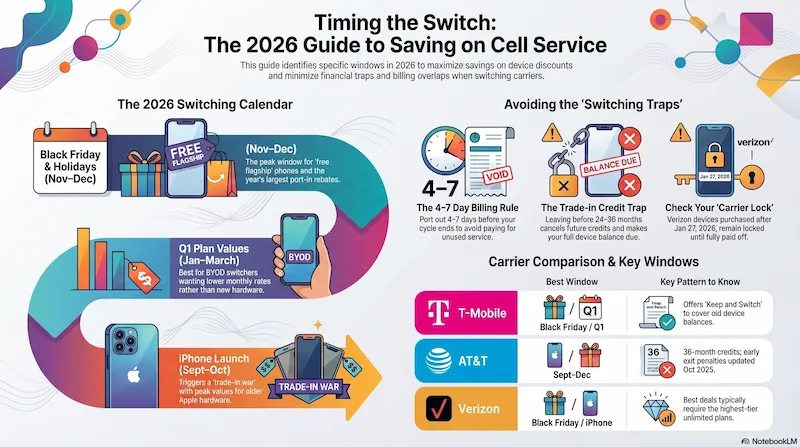
Visual summary created with NotebookLM · Research and analysis by SwitchNinja Staff.
The switching calendar: when carriers compete hardest
Black Friday / Holiday Season (November–December)
This is when carriers fight hardest for new customers. Expect the deepest trade-in bonuses, "free flagship" offers tied to premium unlimited plans, BOGO promotions, and the largest port-in rebates of the year. T-Mobile, Verizon, and AT&T all run competing campaigns targeting each other's customers.
Best for: Anyone wanting a new device bundled with the switch. If you're bringing your own phone, the plan pricing advantage is smaller — January may serve you better.
iPhone Launch Season (September–October)
Apple's annual iPhone launch triggers a predictable trade-in war. Carriers compete to offer the highest trade-in values for older iPhones, and previous-generation models see immediate price drops. Preorder week often has the strongest trade-in offers — they can taper as supply increases.
Best for: iPhone users with a recent-model trade-in who want to upgrade and switch simultaneously. The new flagship deals often require the carrier's top unlimited tier.
January–March (Q1)
Q1 is historically the highest-volume switching period — people reassess bills after the holidays, tax refunds arrive, and carriers are still in competition mode from the holiday season. March tends to see the most port-in activity of any month. The deals lean toward BYOD rebates, plan discounts, and switcher credits rather than free flagship phones.
Best for: BYOD switchers who want a lower monthly plan without buying a new device. MVNOs like Mint Mobile often extend holiday pricing into January.
Back-to-School (July–August)
Carriers target families and students with multi-line discounts, "4 lines for X" promotions, and bundled deals that include tablets or smartwatches. Device deals are usually mid-range rather than flagship-level.
Best for: Families adding lines for kids starting school or college, or anyone needing a multi-line family plan at a lower per-line rate.
When in your billing cycle to switch
Seasonal timing gets you the best deal. Billing cycle timing keeps you from throwing money away.
The rule: switch 4–7 days before your cycle ends
Most major postpaid carriers — Verizon, AT&T, T-Mobile — do not prorate your final bill. If your billing cycle renews on the 1st and you port out on the 3rd, you may still owe the full month. Switching 4–7 days before renewal ensures the port completes before a new cycle triggers, and gives you a buffer if the transfer takes longer than expected.
For MVNOs (Mint Mobile, Visible, US Mobile): Give yourself a 7–10 day buffer. Porting from smaller carriers can occasionally take longer if account verification issues or transfer holds need to be resolved.
Don't forget add-on lines: Tablets, smartwatches, and hotspot lines often don't cancel automatically when you port out your primary number. Verify each line is closed — they'll keep billing if you don't explicitly cancel them.
Does the "end of month quota" theory actually work?
The theory: sales reps get desperate near month-end to hit quotas and will offer better deals. The reality is more nuanced.
Where it's real
- In-store and authorized retailers
- Waived activation or setup fees
- Bundled accessories or gift cards
- Retention/cancellation departments
- Third-party dealers (Costco, Sam's Club)
Where it doesn't apply
- National online pricing
- Advertised plan prices
- Device trade-in values
- Port-in bonus amounts
- Corporate store promotions
When NOT to switch — the traps that cost people the most
Trap 1 — Most expensive mistake
You have active trade-in promotional credits
Most "free phone" deals at AT&T, Verizon, and T-Mobile are structured as 24–36 months of monthly bill credits that offset your device installment balance. They look like discounts — they're actually financing agreements. If you port out before the credits run out, two things happen simultaneously: all future credits stop, and your remaining device balance accelerates to your final bill.
AT&T updated its chargeback policy in October 2025: switcher offers now carry a 36-month commitment with graduated penalties — 100% of remaining credits clawed back if you leave in months 0–12, 50% in months 13–24, and 25% in months 25–36. This makes early exits from AT&T promos significantly more expensive than before.
How to check: Log into your carrier app and look for any monthly bill credit tied to a device promotion. If you see one, calculate the remaining term × monthly credit amount — that's the cost of leaving early.
Trap 2
Your device isn't unlocked yet
Carrier-locked phones won't work on another network, even if physically inserted with a new SIM. AT&T requires the device to be paid off and active for at least 60 days. Verizon updated its unlock policy in January 2026: devices purchased after January 27, 2026 may remain locked until fully paid off — the previous automatic 60-day unlock no longer applies to newer purchases. Devices bought before that date still follow the old 60-day rule.
On iPhone: Settings → General → About → Carrier Lock. Should say "No SIM Restrictions."
Trap 3
You recently received a port-in rebate or BYOD gift card
Many port-in gift cards, BYOD rebates, and switcher credits require 90–180 days of continued service before they're fully processed or before you're eligible to keep them. Leaving too soon can trigger a chargeback or result in a denied rebate. Check the terms of any offer you accepted before starting a new switch.
Carrier-specific timing patterns
| Carrier | Best window | Pattern to know |
|---|---|---|
| T-Mobile | Black Friday, Q1 | Tends to extend holiday deals into January. Keep and Switch can cover remaining device balance from your old carrier — strongest overall switcher incentives. |
| AT&T | September–December, Q1 | Trade-in values are a focus — often high regardless of device age or condition. Watch the 36-month credit structures; early exits are expensive. |
| Verizon | Black Friday, iPhone launch | Focuses on premium bundle value (streaming add-ons, ecosystem perks). Best device deals typically require the top unlimited tier. |
| Mint Mobile | Holiday season, Q1 | Holiday deals frequently extend into January. No device financing traps — SIM cards can often be purchased on promo and activated up to 45 days later, letting you lock in a deal before your old cycle ends. |
⚡ SwitchNinja take
The best time to switch is when you're ready — not trapped.
If you want the biggest device deal: wait for Black Friday or the September iPhone launch. If you're bringing your own phone and just want a better plan: January–March is strong, and often underrated. Both cases: switch 4–7 days before your billing cycle ends to avoid paying for a full month you won't use.
The most common timing mistake isn't picking the wrong month — it's leaving while you still have 18 months of trade-in credits outstanding. Before you switch, check your carrier app for any active bill credits. That number tells you the real cost of switching today versus waiting.
Ready to make the move? See our Verizon vs T-Mobile comparison or read the Mint Mobile review for a no-contract alternative.